Skip to content

A Proud Life

The World Needs More Love Letters published an F. Scott Fitzgerald quote I loved today:

life you're proud of

Seeing this made me think about something I read last week that has stayed with me ever since.  A blogger (Hands Free Mama) wrote a post called The Important Thing About Yelling.  Here’s the part of it that deeply resonated with me:

“My oldest daughter had gotten on a stool and was reaching for something in the pantry when she accidentally dumped an entire bag of rice on the floor. As a million tiny grains pelleted the floor like rain, my child’s eyes welled up with tears. And that’s when I saw it—the fear in her eyes as she braced herself for her mother’s tirade.  She’s scared of me, I thought with the most painful realization imaginable. My six-year-old child is scared of my reaction to her innocent mistake.  With deep sorrow, I realized that was not the mother I wanted my children to grow up with, nor was it how I wanted to live the rest of my life.”

Like Hands Free Mama, I’ve definitely yelled at my kids.  I’ve most certainly blown up at people I love.  I absolutely fumed at my husband this week for forgetting one little detail about the weekly schedule.   And those are not proud moments.  They are massively UN-PROUD.  But they ARE the moments that can lead to the biggest change.  They’re the turning points…the ones that feel tough enough to make us want to start over…in a small way or in a big way.

So coming back to this quote, I love it for a few different reasons.  First, I like the word pride because only each of us knows that makes us proud.  It’s not about a judgement or an external view of how our lives should be.  It’s just about a feeling.  Our individual feeling.  Second, I like that these few words are a simple reminder that we can always change, no matter what.  Each of us deserves to live a life we’re proud of — whatever makes us uniquely proud — and that life can be re-defined any time we want to re-imagine it.

What in your life is making you feel proud?  And where are you ready to clear the slate?

Daily Progress

progress

When my kids were babies, I remember getting to the end of the day and saying to my husband/friends/whoever would listen that I felt like I had been “busy,” but hadn’t gotten anything done.  I’d look around before going to bed and see (most importantly) an amazing tiny human being….but also a pile of half-folded laundry, a stack of mail that had been opened but not dealt with, and a bunch of veggies that had been cleaned but not cut.  I was trying my best to treasure the time with that amazing tiny human being and “relish the early days of motherhood” as everyone was telling me to do, but I had a nagging sense of frustration that I couldn’t ever put my finger on.

I recently came across a concept at work that helped this make sense.  There’s an idea called “the progress principle,” which was popularized when a Harvard-based husband and wife team published a book called The Progress Principle: Creating Small Wins to Ignite Joy, Engagement, and Creativity at Work.  The core premise of the book is simple: making progress on meaningful work is one of the core things that motivate people day-to-day (similar to the “small wins” concept in goal setting).  It’s not about the big “aha” or the massive breakthrough; it’s about the small steps that lead to forward progress (toward things we care about) every single day.  It’s about watering the carrots so they can grow…knocking out a training run…writing a page of a book, not the whole thing…knitting the arm of the sweater…writing more of the code than you did yesterday…eating a few stalks of broccoli every day.

Wait, you might be wondering, isn’t taking care of a baby the ultimate example of moving forward day-to-day (after all, keeping them happy and fed and slept and alive IS definitely progress)?  Of course it is, but in order to feel a sense of forward motion, you need to be focused on the daily changes, not the big milestones.  Looking back, I was focused on the wrong things.  I was looking for a sense of progress on tasks that didn’t matter (laundry + mail) and I was overlooking the amazing day-to-day growth of my child because I was focusing the wrong thing (the big and infrequent milestones).

I wish someone would have told me to reflect on what happened each day as a new mom.  The messages I remember were about living in the present (which yes, is ideal, but very difficult to do all the time) and the big milestones.  I feel like there wasn’t enough talk about the fuzzy space in between — the small, daily wins which actually help us keep going. This isn’t about a creating massive checklist or a building a super busy life…it’s simply about working hard to make progress on the things that matter to each of us, and celebrating that progress.  A heightened awareness of this may help us understand why some days are happier/more energetic/more creative than others…and what we can do to make those great days happen more often.

Do you notice your mood changing on days when you make progress versus days you don’t?   How do you think about the idea of progress co-existing with living in the moment?

Choices

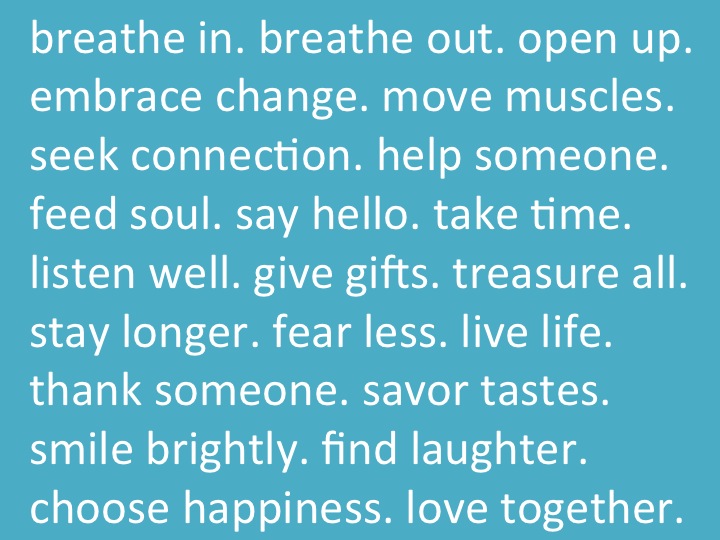
I read a friend’s blog post today about choosing happiness, and it was a great reminder that our state of mind…our way of being…is often a choice.  Not always, but often (at least for those of us in the developed world where all of our basic needs are met) it’s up to us to quiet our powerful inner critics and channel our true…honest…kind…open selves.  So instead of writing a post today, I strung together some words that I can use to remind myself of the choices I can make every day.  Here they are…

choose

What else would you add to the list?

Strength in Numbers

cover.jpg

A few weeks ago an old friend came over for dinner, and on the way out the door he asked if I wanted to join him for an epic cycling event he was doing the first weekend in June.  Loving the idea of something epic…and totally ignoring the fact that my training schedule has been far from epic…I paid my $60, signed up, and entirely put it out of my mind until Saturday night when panic set in and I wanted with all my might to bail on the 5am wake up call and sleep in, eat bacon and eggs with my family, and read the Sunday Styles section.

I’m quite sure that the only reason I got to the starting line was because I knew my friend was going to be there.  And I’m even more sure that the only  reason I finished the 200km ride was because he and a bunch of his friends from SF2G (the “San Francico to Google” cycling group) encouraged me to stick with them, ever-so-patiently waiting at the bottom while I slowly white-knuckled the harrowing descents, and re-grouping at the top of each of the massive climbs.  Yes, the scenery was beautiful and the challenge was invigorating, but the camaraderie made the ride.  These people (literally) pulled me through a windy patch, told me what to expect as we climbed, and had a can of Coke waiting at the top of the last climb.  They were optimistic and welcoming and fun…inseparable in my mind from the ride itself.

This is just one example of impact training/racing partners and groups can have.  There’s tons of research supporting this idea that exercising in a group pays off.  A few years ago, The Economist covered a study finding that training in a synchronized group may heighten tolerance for pain due to the simultaneous endorphin release caused by exercise and collaboration.  A 2009 University of Pennsylvania study found that exercising with a partner boosts weight loss.  And for people who can’t find real-life training partners, the fitness industry is going very social very quickly (I covered this a few months ago in my post “To Track or Not to Track“).

Without a doubt, training partners and groups make workouts better.  They make them more fun.  They make us work harder.  And as was the case with me yesterday, they can even help us do things we likely couldn’t/wouldn’t do on our own.  So how do we find these magical people?  Here are a few simple ideas:

  1. Find a formal group.  Pick your sport and then visit a local store related to that sport (i.e., local running store or bike shop) and ask them if they lead or know of any good training groups
  2. Create your own group.  Link up with a partner or group through your gym (people who run on treadmills probably also like to run outside)
  3. Be friendly at the finish line.  Talk to the people who finish around the same time as you in races/events; if geography is in your favor, you already know you have a partner who is the same pace
  4. Post an ad.  I know this sounds like a total stalker move, but I met my favorite training partner of all time and still one of my dearest friends (see former post “Curtis Camp“) when I posted in a mother’s group in search of an early morning running partner
  5. Just say yes.  Even if you feel nervous about joining a group for a run/ride/swim/row/whatever, if someone invites you, say YES.  Ignore the self-judgement (“I’m too slow for them”), and just go.  Almost without a doubt, it will beat working out solo

So if you’re needing motivation, a challenge, or simple a bit more fun in your workout, the answer might be calling a friend…or a even a stranger.

Have you ever trained/raced with a friend or group who pushed you harder than you would have ever pushed yourself?   How did you find that person/group, and what made it such a great fit? 

Laugh More

laughter

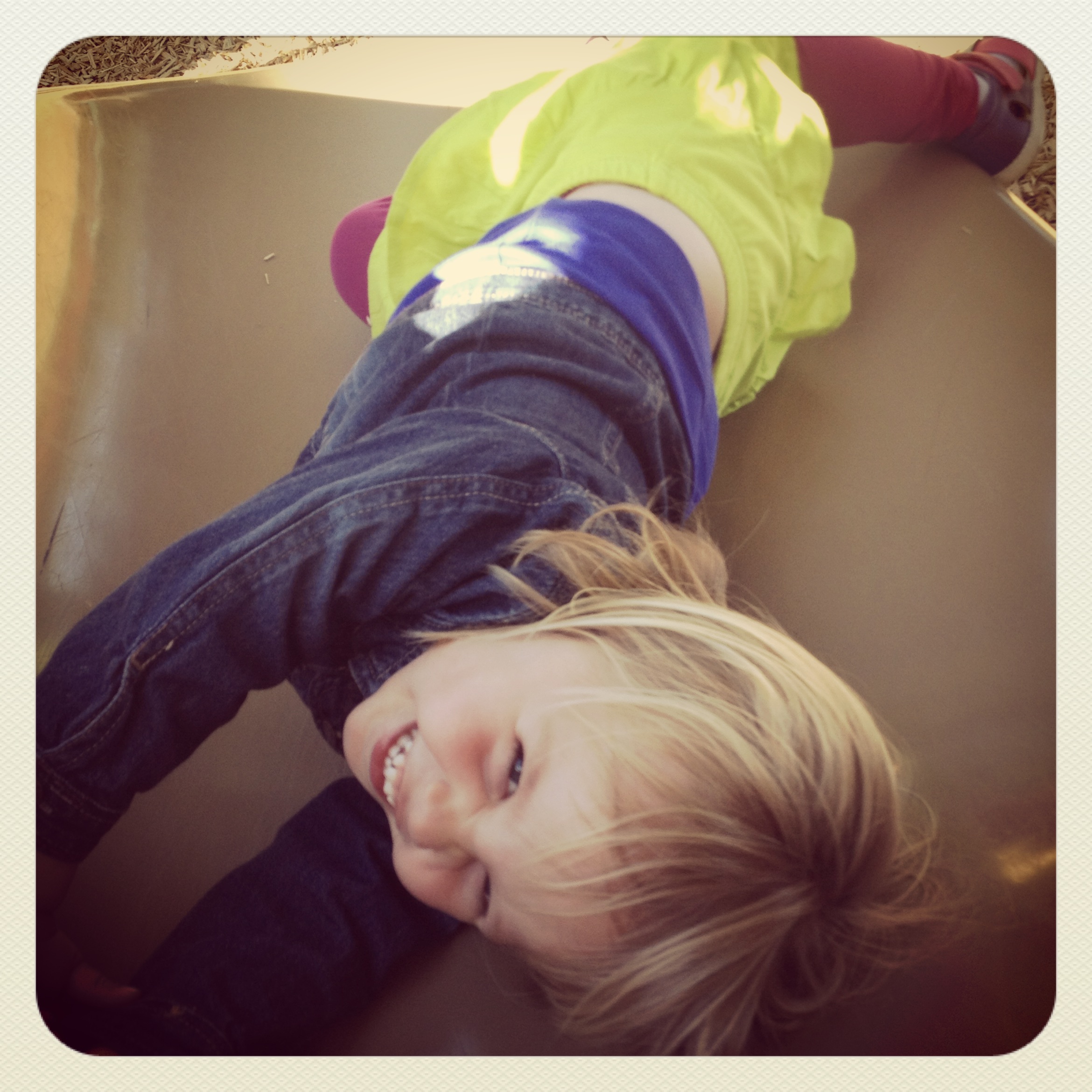
When was the last time you laughed?  Like really, really laughed — maybe until your stomach muscles felt tired and your eyes watered?  I’ve been noticing something about laughing lately.  Kids do it constantly.  ALL. THE. TIME.  When they wake up…when they are supposed to be eating…basically, whenever they’re not screaming.  According to research, the average four-year-old laughs 300 times every day.  Considering the average four-year-old is only awake 12 hours/day, that kid is laughing 25 times per hour.  That kid is laughing more than once every THREE MINUTES.

But adults don’t do it very much at all.  The average 40-year-old laughs four times per day.  FOUR TIMES PER DAY.  When I think about it, I think I only laughed once today (yikes).  How does this happen?  What changes between 4-yr-old bliss and 40-yr-old seriousness?  Why do we forget how to laugh, and are there things we can do to remember?

Most of us know that laughing is good for us — it makes us less stressed, more optimistic, more hopeful, and more resistant to disease.  So I don’t think we need a reason to remember.  I think we need more examples.  One of the coolest things about laughing is that it’s contagious.   We see people doing it, and we want to do it.  We hear it, and we feel better.  We come across something other people say is funny (like the “Worst-End-of-the-Schoolyear-Mom-Ever” post than went viral in the mom community yesterday and made me laugh), and we read/watch it.  Joy breeds joy.  Giggles create giggles.  And we all feel a little bit better.

So this weekend, my intention is simple: laugh more.  If I find something funny, I”m going to make a point to share it.  Out loud.  With another person.  That might be all it really takes!

What’s the last thing that made you laugh really hard?  And if it’s watchable/readable, can you PRETTY PLEASE comment and share it?

Yin + Yang: Brussels Sprouts + Bacon

tonight's dinner!

tonight’s dinner!

Until about a few years ago, I thought I hated brussels sprouts.  When I’m honest with myself, I’m not sure I ever gave them a fair shot; instead compartmentalizing them into the same category as lima beans (which I indeed still hate).  I finally tried them out of solidarity when Sean made a brussels sprouts, bacon and parmesan dish for Thanksgiving dinner at my parents’ house.  And from that point forward, I was a changed woman — gobbling up brussels sprouts when I saw them on menus (beginning a long love affair with the brussels sprouts chips at Marlowe in San Francisco) and cooking them at home often.

Eating solo with the kids tonight, I scrambled to quickly cook something green and tasty, and shocker…brussels sprouts were in the fridge.  It took five minutes flat to…

…take them out of the fridge

…wash them

…halve them

…toss them with a handful of pancetta over medium-high heat

…and sprinkle them with salt and pepper

This is the one of the easiest ways I know to feel like I’m eating something fancy with minimal work…and get loaded up on vitamin A, vitamin C, and folic acid to boot.  So next time you’re looking for a healthy veggie, reach for the brussels sprouts.  And don’t be afraid to add some bacon/pancetta to make them extra delish.  After all, bacon makes everything better, doesn’t it?

Do you have a brussels sprouts dish you love?  Or do you have another veggie that helps you get a quick and easy fill of the green stuff?

P.S. If you’re looking for some fun dinner table trivia, 1) the first written reference to brussels sprouts dates to 1587, 2) most U.S. production is in California, and most importantly, 3) Prince William and Kate Middleton love snacking on brussels sprouts and cream cheese.

What Would You Do If You Weren’t Afraid?

afraid

I promise, this isn’t a post about whether to Lean In or lean out or bend over or do the limbo.  There has been a ton of thought-provoking and divisive stuff written on this topic, and I’m not going there.  At least not today.

But I am going to talk about a video Sheryl Sandberg posted and blogged about on leanin.org yesterday.  It’s a 3-minute video called “What Would You Do If You Weren’t Afraid?,” and it includes short clips from a diverse group of women talking candidly about their fears and what they’d do if they weren’t afraid.  Targeted at this year’s million+ female college graduates, the video is refreshingly devoid of the working/stay-at-home mom dialogue that has defined LeanIn to date.  Instead, it’s a video for all of us.  It spoke to me, and I’d bet that the notion of having and overcoming fear is something every woman I know (and actually, every man I know) can relate to.

I think this particularly resonated because Wellfesto is one of my “What Would I Do If I Weren’t Afraid” things.  Despite deeply caring about and voraciously learning about health and well-being since I was a little girl, I never had the courage to put my voice out into this crowded space.  I told myself things like “I’m not a doctor, so people won’t listen to me.”  “I’m not a writer, so why should I start a blog.”  “I might offend someone.”  “I might say the wrong thing.” “People will think I’m stupid.”  “What if I don’t have anything new to say?”  “What if I can’t keep up my commitment to it?”  And I let the thoughts and questions and ideas swirling around in my head stay inside my head for years.

Finally, in December, I decided I wanted to say them out loud.  I started to gain confidence that I actually do have a unique point-of-view about well-being.  I realized I was in the midst of a struggle so many people live every day — how to take care of myself while trying to take care of a family — and I thought there was more to gain from being in the public eye that there was to lose.  I’ve now been writing every weekday for almost six months.  Some posts feel great and some don’t.  Sometimes hundreds of people read my posts and sometimes three do.  Sometimes no one comments and sometimes I get warm messages from random people who came across a post they related to.  And all of that is OK.  It’s more than OK.  It’s empowering and awesome and real and hard and fun.

We all have fear.  It makes us human.  It’s what we use to keep us safe.  I still have loads of it.  But I’m slowly learning that when you let go of fear, you leave more room for joy.  So if you haven’t asked yourself the question lately, do it today.

What would you do if you weren’t afraid?  And what can you do right now…in this very moment…to take a step toward doing that very thing? 

The 4:1

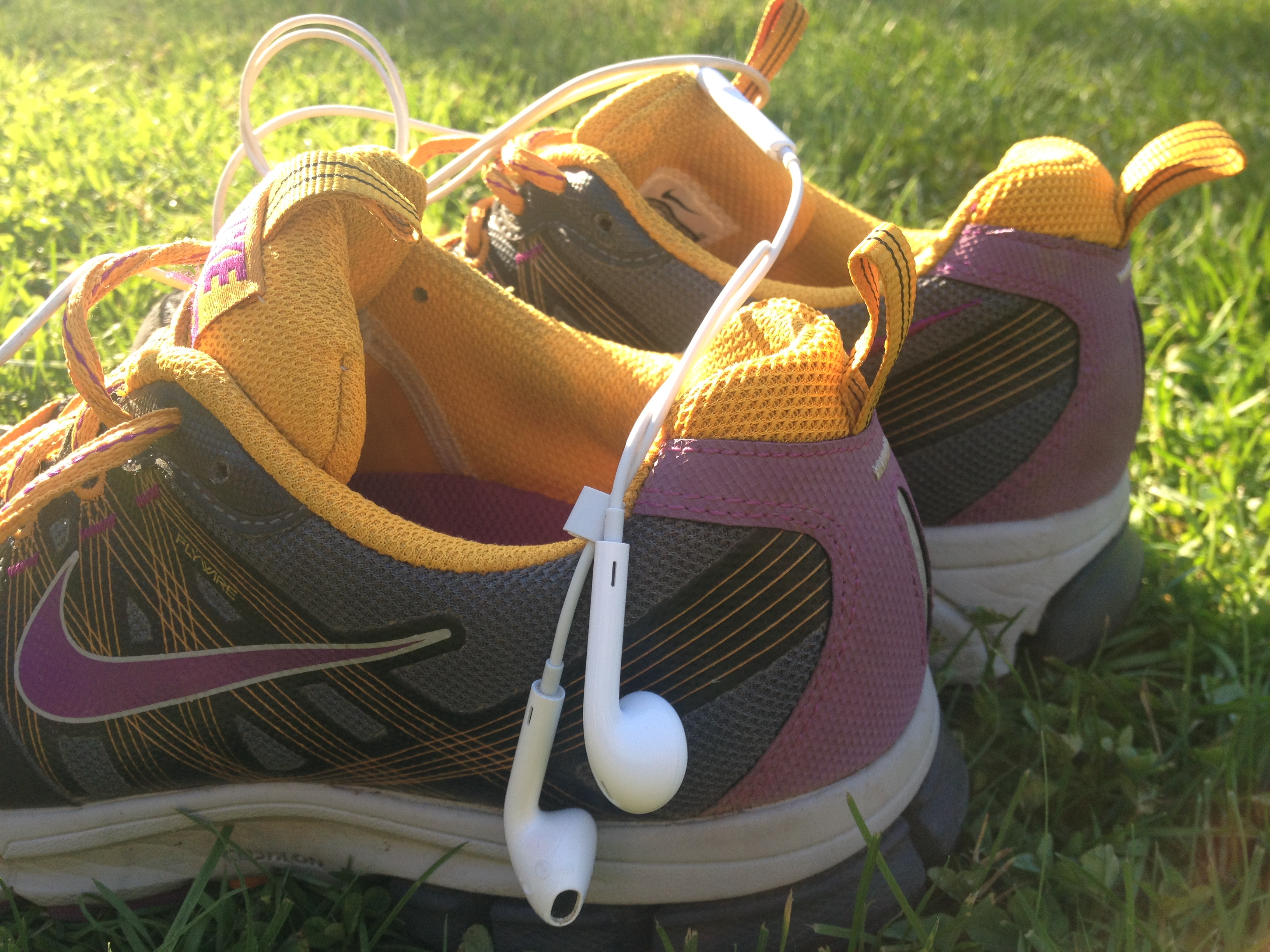
photo (2)Pumped to have a long Memorial Day weekend at home, between Friday and this morning, I got my workout on.  This translated into running 33 miles, doing a TRX class, and taking a spin class…which was awesome (and a lot for me these days).  This then translated into me wanting to sit in a chair all day today to avoid using my aching muscles…which was NOT awesome.  As I sat down to write about rest, I remembered a study I covered a few months ago reporting that the magic number of workouts per week is four…for exactly the reason I experienced today.  Study participants who exercised more than four times per week were more likely to spend their non-exercise time sitting and resting than the other groups.

I’m not sure that my magic number is 4X/week, but I am 100% sure it’s not 7X.  We all need rest.  Not “sit around and watch cartoons all day” rest, but a physical and psychological break from a formal workout.  Since having kids, I’m not super proactive about planning rest days (they almost always seem to happen naturally), but I do try to keep loose track of workouts and take a day of rest after four days of medium/hard workouts (I call this the 4:1).  Beyond knowing that I followed this plan for three months during the Blue Planet Run without a twinge of injury, I also like it because it’s easier for me to remember than some elaborate schedule.  It isn’t perfect…and sometimes it ends up as the 3:1 or the 4:2, but it’s something to aim for and it’s a good reminder to take time to pause…rest…sleep late…stretch…relax…re-set.

How important are rest days to you as you’re planning your workouts?  Do you schedule them in or let them happen? 

Cutting Through the Clutter

I’ve been thinking a lot about all of the “noise” in my life lately.  I’m signed up for a gazillion blogs/e-newsletters, I get the snail mail New York Times, Fast Company, Outside, and Real Simple, I have four email accounts, paper lists, electronic lists, and lists swimming around in my head.  I’m not sure what percentage of this is “media porn” versus substantive information, but I’m guessing the balance could be a whole lot better than it is.  This topic of noise/bombardedness seems to be in the media a lot these days as people are increasingly talking about things like intention and purpose and signal…and how we isolate those things in our information-filled lives.  For example, an author named Douglas Rushkoff recently published a book called Present Shock: When Everything Happens Now, which talks about our social adaptation to a present-focused narrative, which can either be energizing or disorienting, depending on how we handle it.

This idea of noise — and how to sift through it — is most interesting to me as it relates to our health.  This was actually the foundation of wellfesto — a belief that if we all could get clearer about what matters to us, based on our individual stage in life and priorities and interests and passions — we’d be able to better focus the information and inspiration we process in order to take care of ourselves.  I love the idea of being clear about what matters to us, and then designing information flow based on that.  Technology writer Doc Searls was quoted talking about this exact thing in yesterday’s New York Times business section: “right now, fitness enthusiasts who use blood pressure monitors, calorie calculators, and movement sensors typically can’t collate the data for a unified view of their wellness…if people could easily integrate their data, they might be able to correlate weight loss to a particular workout routine or diet.”

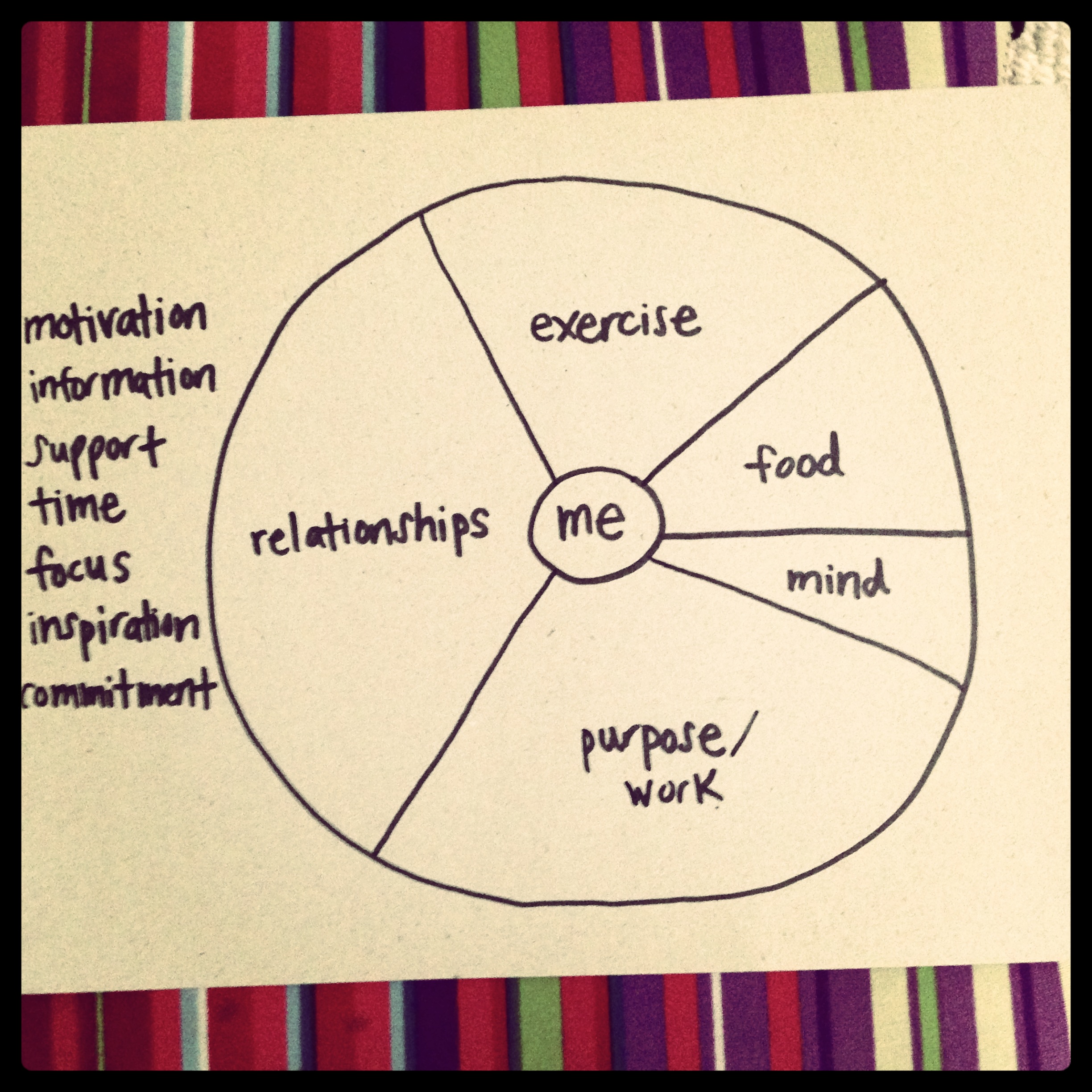
I’m sure people are frantically scrambling to build a platform that makes sense of not just our physical health, but our overall well-being.  And overall, I think this is a good thing.  Probably a great thing…maybe even a world-changing thing.  But the value of all of this information hinges on what we actually do with it.  What signal are we looking for, why, and what decisions/behavioral changes do we make based on what we learn?  What unique blend of data matters to US?  I have a super rudimentary way of thinking about this, which is a pie graph of what I’m focusing on at any given time.  Here’s the graph I made this morning:

photo(22)

It shows where I’m focusing my effort right now…not necessarily my time (I probably spend more time making and eating food and using my brain than this graph shows)…but my energy.  Once I sketch out how I’m focusing my effort, I think about what I’m looking for in each category.  This usually includes one/some of the following: motivation, information, support, time, focus, inspiration, commitment.  Once I know what I’m working on and what will help propel it forward, I can make clearer use of my time and find signal in noise.  It’s imperfect, but its a good check now and again to try to focus on the things that matter most.

What tools do you use to keep track of your health?  Do they add value or noise?  Do the signals you’re looking for change over time?  If you could design one tool to keep track of your overall well-being, how would it work?  

Eat Local

Even though I now live in a place where “summer” extends far beyond the short window when schools close and summer camps open, I still love the way Memorial Day marks the unofficial (pre-solstice) beginning of the season of long days…meals outside…sweaty workouts…family downtime…new top 40 hits…bare skin…BBQs…beach reads…skinny dipping…s’more making…fireworks…nostalgia…FUN!  To kick off the season, I’m going to make a special trip to the farmer’s market this Sunday to stock the kitchen with seasonal deliciousness (something I’m trying to do more consistently).  If you’d like to do the same, Field to Plate offers a comprehensive list of farmer’s markets around the U.S.  Happy (and healthy) eating this weekend!

On a related note, I need some new food inspiration.  Do you follow a food blog the inspires you to cook great, seasonal dishes?  I’m thinking about trying out a few of Saveur’s 2013 Best Food Blog winners, but I’d love recommendations!

poster by my-name-is-annie via deviantART

poster by my-name-is-annie via deviantART

Alphabet Scramble

Learning from parenting and life, while trying to get dinner on the table

The Lemonade Chronicles

A quixotic quest for the bright side.

mamajamas mom

don't sweat the baby stuff

The Development Sherpa

by SBK & Associates

wellfesto

hacking health, designing life

Rudeysroom

Rudey's Room

Building Customer Driven SaaS Products | Jason Evanish

Posts with strategies and tactics on building great products and how to be a better leader

The Blog of Author Tim Ferriss

Tim Ferriss is the author of five #1 New York Times bestsellers and host of The Tim Ferriss Show podcast.

Reflections Corner

hacking health, designing life

The Marginalian

Marginalia on our search for meaning.

Greater Good: Parenting & Family

hacking health, designing life