Skip to content

Unmoments

I write a lot about ideas for getting the most out of every day – how to fit in workouts and dates and healthy meals and gratitude and self-care amidst crazy and busy and overplanned lives.  So today I thought I’d write about something just as important, and arguably even more meaningful: the moments in between.  The “unmoments.”  These are the moments when our brain has time to wander and rest, to drift from thought to thought and idea to idea. For me, these moments usually happen when I’m running or doing an art project or folding laundry or stirring a soup, when my mind is distracted enough from day-to-day stress to be free to begin to both generate new ideas and connect existing ones in interesting ways.

Most often known as “shower moments,” there is a long history and tons of research about down time and its connection with creativity.  Mihaly Csikszentmihalya, the Hungarian positive psychology guru best known for his work on Flow refers to these moments as “incubation,” of the time away from work itself where our subsconscious minds are free to work on our behalf and deliver ideas back to our conscious minds.  And based on the experience of wildly successful idea people (Steve Jobs reported getting tons of great ideas following meditation), it works.

We all need space to do and space to just be, and we need a healthy balance of both. If we’re spending most of our time “being,” we may not have a lot of material to incubate.  But if we’re spending all of our time doing, we are likely to miss the big ideas and aha moments that come with processing our day-to-day lives.  So, if you’re not already leaving space for these unmoments in your life, here are a few simple things you can do to make room:

  • Observe yourself for a week.  When do you have the most new ideas or even revelations about things that have been leaving you stumped?  When you’re driving?  Swimming?  Doodling?
  • Make time.  Once you identify what activities help your mind drift, try to do those things more often…even every day if you can.  Shift your thinking about this time from one of luxury to one of necessity and block it out on your calendar just as you would an important meeting.
  • Jot down your thoughts.  If you have ideas during your “unmoments,” jot them down (I literally keep a piece of paper taped on my wall…it’s that simple).  You may see patterns in your thoughts that will increase your understanding about something in your day-to-day life.

What works for you?  When do you incubate your best ideas, and how do you make time for it?

Six Races That Push Human Limits

I read an article this morning about The Barkley Marathons, a 100+ mile footrace on unmarked trails in Tennessee.  This race is totally insane (read the article…even if your only reason is to have some good dinner table conversation up your sleeve).  The cumulative elevation gain can be as much as 60,000 feet. Only 35 people can start the race each year (and less than 2% of them finish), and the race starts before it even starts, as participants have to figure out how and when to sign up.  And there’s some token quirkiness involved too — participants have to find pages of books along the course and tear them out to prove they followed the correct route.

This article led me to some quick research I’ve been meaning to do for awhile about what the craziest, hardest, and or most bizarre organized physical events across the globe.  Here are a few I either knew about or stumbled across tonight…

  • Siberian Black Ice Race — This race claims to be “longer than England, colder than vodka, and harder than granite.”  It starts in Irkutsk, which sits on the short of Lake Baikal (the deepest lake in the world…and the most freezing, according to my toes) and traverses 379 miles of Siberian tundra on foot.  Participants are required to be self-sufficient throughout the race.
  • Spartan Death Race — Wood chopping and carrying, rock lifting, fire building, and memorization, this 48-hour adventure race works the body and the mind.  Only 10% of competitors finish.
  • The Atlantic Rowing Race — Every two years, rowers race from the Canary Islands to the West Indes.  The next race is slated for December of this year 
  • The Iditarod — This is an 1868km dogsled race across Alaska (that my adorable and insane husband wants to do someday).  With wind chill, temps can get down to -73C, and the event can take up to 15 days (of sitting in raging snowstorms) to finish.
  • Finland’s Wife Carrying World Championships — Male participants carry their wives through a 250-meter course including obstacles.  All to win their weight in beer!

What’s next — airborne flip contests in space?  What’s your take on these races — totally insane or totally awesome?  Do you have any crazy races on your calendar?

And if you’re more into reality than insanity, check out a few I mentioned last week.

Staying In the Now

handsI read an essay last night called “Suddenly, They’re All Gone” (published in Tuesday’s New York Times Science section).  Written by a journalist reflecting on her years caring for her elderly relatives (her mother, mother-in-law, father-in-law, and aunt), it quickly pulled me in and ultimately made me cry.  I was teary for a few reasons…she wrote it with so much love and care and honesty…it made me think about the inevitable aging process that we (thankfully) don’t think of on a regular basis…in a lot of ways, I feared being her some day…and it reminded me of the many, many people my own parents have cared for in their later years, sacrificing their own lives to bring loved ones moments of brightness and joy amidst long days often spent alone.

The essay’s main point is this: when you’re “in it” (or “drowning,” as the author calls it) — dealing with the doctors and the caregivers and the appointments and the logistics of caring for another person — all you can think about sometimes is getting out of it…moving past it…what life might be like when it’s over.  But unlike other challenging times (like the terrible two’s, for example), when you’re dealing with someone nearing the end of their life, “getting out of it” doesn’t mean entering a new and beautiful phase that makes it all worth it.  It means the end.  Rather than growing and expanding, the closing of this chapter leaves a hole.

The author talks about what she misses — namely, being in the moment with the people she cared for.  She talks about the joy of bringing simple, physical comfort — similar to cradling a fussy child.  She talks about knowing what small things will make someone smile, and doing those things often.  And she talks about listening to the stories about the past that seem to come rushing out in people’s later years.

It was this talk of missing that made me cry, both thinking about the people I miss who are no longer with us, but also, the things I miss in my everyday life as my brain darts between past and future, rarely pausing in the present long enough for me to soak it all in.  I often find myself in the “when we get through this (i.e., the terrible two’s or a rough patch at work or a tense time in my relationship), it will be better and worth it” mindset.  And while admittedly this thinking keeps me sane, it also gets me out of the present…out of the “now.”  So this article was a timely reminder that as Jon Kabat-Zinn put it in his talk about Wisdom 2.0, “there will never be another now.”  It was the jolt I needed last night to remind to me soak it all up — the beautiful moments and the challenging moments and everything in between.

When is it hard for you to be in the “now,” and what helps you stay in the present moment?  

Yoga in the Living Room

admittedly not my living room, but only yoga photo i could find!

admittedly not my living room, but only yoga photo i could find!

I wasn’t able to get a workout in during the day yesterday, and even worse, I spent most of the day sitting (blech).  So I was bound and determined to get some sort of exercise before the day’s end, even if it meant after getting the kids to bed and returning some emails…which is what it indeed was.  And at 9pm, I finally started moving through a vinyassa yoga practice guided by Jason Crandall on YogaGlo.  YogaGlo is an online yoga experience, streaming hundreds of classes (some taught by famous teachers, including my favorite NYC yoga instructor, Elena Brower), into your home.  Classes range from 5 minutes to 120 minutes in duration, and easy to very challenging in difficulty.  A “membership” offers unlimited streaming for $18/month (you can do a 15-day trial first, which is what I did last night).

Before weighing in on the class, three disclosures:

#1: I’m admittedly a total snob about fitness classes

#2: The idea of a “canned” workout on TV conjures up weird images of Richard Simmons and unpleasant memories of the old Buns of Steel tape I used to do with my friends in high school

#3: If you would have told me a few years ago that I’d be streaming a yoga class on my computer with my Spotify yoga playlist in the background, I never would have believed it.  But there I was, hanging on Jason’s every move for 60 minutes

So, the final verdict?  While I didn’t love it and would have rather been in a live class with candles and drums and fire dancers and beautiful, sweaty people…I actually didn’t mind it.  It did the job.  It motivated me to finish 60 minutes of yoga at a time of day when I was highly unlikely to do it on my own.  And it was actually moderately difficult (fast pace, lots of arm balances).  I even think I’ll try another class before my trial runs out.  It’s definitely not the same as a real, live yoga class, but if you live in a place where there aren’t great teachers/studios available, or if your only option is to do a class while your kiddos slumber, it’s a pretty darn good option.

How do you feel about home workout DVDs?  Love them or loathe them?  Have you found any that work well for you?

Vitamixing Dinner

Paul-bertolli_s-cauliflower-soup-307470-271247.730x410

Photo by James Ransom (featured on Food52.com)

We’ve been trying to eat more vegetables in our house (grown-ups included) and now have a brand spanking new Vitamix on the counter ready to spin any assortment of fruits and vegetables (and god knows what else) at 240 MPH. Read more

Word Art

Today’s Idea: Surround yourself with visual reminders of the people, places, and things you love.

Going about our everyday lives, it’s all too easy to forget what matters to us most — who we are at the core…what brings us joy…what we love.  There are tons of ways to prompt ourselves to remember — first, doing these things (duh), but when that’s not possible, surrounding ourselves with photos and artifacts and music and books that transport us to times when we really felt like ourselves.

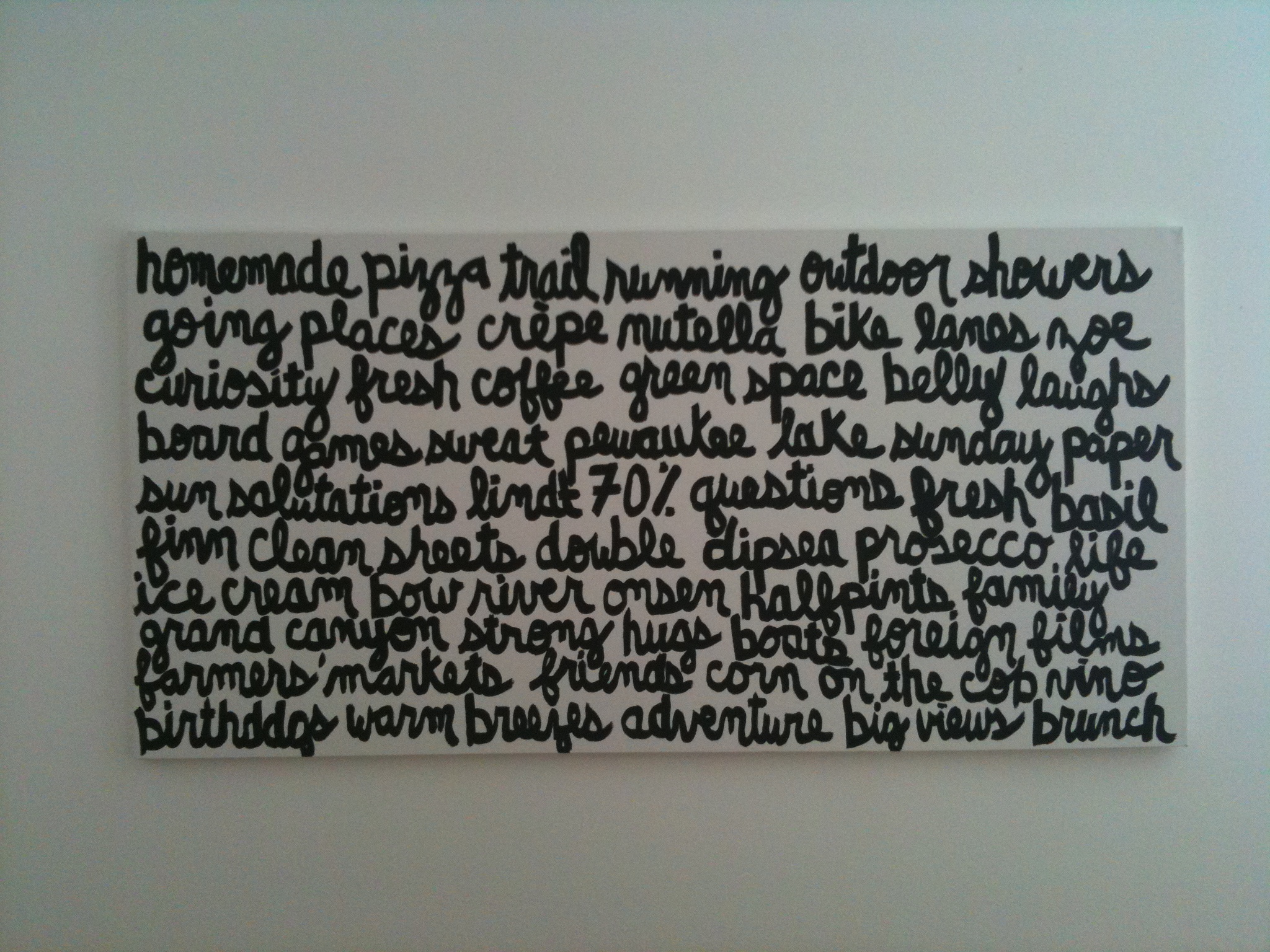
One of the cues that works for me is a painting I made a few years ago.  I love art (and believe that making stuff makes us feel whole), but am not that good at it, so it’s very basic and quite rough.  So it wouldn’t ever hang in a museum, but it does hang on our kitchen wall every day to remind Sean and me of some of the little and big things in life we love.  Here it is:

word art

Have you ever made something that really captures who you are and what you love?  What was it, and where is it today?

Early Bird Gets the Worm?

Today’s Idea: Set your wake-up time and stick to it like glue…7 days a week. 

If you’re wondering if it’s possible to shift your sleep schedule, read on…

I so very desperately want to be a really early riser, and over the years, I’ve tried to convince myself that I am one.  After all, when I actually manage to crawl out of bed before the sun rises, I love it (see my previous post about pre-dawn workouts).  There’s something spectacular about the stillness of the pre-dawn hours, when everyone in the house is peacefully sleeping and the stars are still sparkling outside the window.  And NPR’s Morning Edition at 5am beats a screaming child any day of the week.

But when I’m really honest with myself, I don’t think I fit the “really early riser” bill.  I’ve been getting up super early (5/5:30am) a few times a week for years, and it’s still MASSIVELY PAINFUL every time the alarm goes off.  I want to press snooze every single time, without fail.  This time of year is the hardest, when the spring time change makes darkness persist until the clock strikes seven…which led me to google “is it possible to change your circadian rhythm?” last night.  This search first led me to a slew of articles differentiating early birds + night owls (supposedly early birds are happier and healthier, and night owls are more creative), which were interesting but not particularly helpful because they generally don’t address “really early” (in most studies I read, early birds wake at 7am and night owls wake at 11am, so by their definition, I’m an early bird…just not an early bird by “trying-to-fit-it-all-in” standards).

I did find a good article in the Washington Post, however, which gave me hope that it IS difficult, but definitely possible to change our circadian rhythms.  The article gives a few tips for how to do this, the most relevant one for me being “Set your wake-up time — and then stick to it like glue. Ideally you should get up at the same time every morning, including — gasp! — those precious weekends. If you sleep more than 90 minutes later on a Saturday or Sunday, you will affect your body clock, readjusting it to the later wake-up time just as you have to get up early again Monday morning.

Aha…I think I may have figured out my problem.  I have always been in a weird cycle of waking early some days and then rewarding myself with sleep on other days.  Thinking about it now, this is sort of like eating a vegan diet two days a week and then gobbling up burgers the other five.  The body’s response: What the F is happening here?!  I’m realizing my focus needs to shift to sustainability (not forever, but for longer than a day or a week).  This then becomes a question of “me time” versus sleep (sometimes the only time I can get me time is before the kids wake up and after they go to sleep)…which then plays into prioritization.  Hmmm…shorter workout, more sleep?  Longer workout, less work?

These are tough choices, but they’re made in service of the fact that sleep is one of my non-negotiables (within reason…I DO have little kids).  And according to The New York Times, if I don’t get at least six hours, I’m more likely to gain weight.  So my current quest is to find a rhythm that I can make a habit….even if it means a 5:30am wake up call every day of the week.  I’ll post again once I’ve actually nailed that rhythm (note: at my current rate, this might be 2020).

How do you make sure you get the sleep you need and get the things done you want and need to?  Have you successfully overcome an allergy to super early rising?  If so, please share your tips!

P.S. If you’re trying to get up earlier than your body wants to, you might want to lessen the blow by checking out this list of the Five Best Alarm Clocks


Le Jogging

BPRA friend recently sent me a blog post about running in Paris, or “Le Jogging” (thanks Kim), which was a great commentary on how different cultures think about exercise.  Here’s an excerpt I loved:

“While I get the sense that Parisians are becoming more and more intrigued by fitness, there is still something funny about watching a Parisian jog with intent….I’m referring to the ones who run as if they’re making a pact to themselves that they can still smoke and drink to their heart’s content as long as they squeeze in a half-hour circuit; their stride is wobbly and their cheeks are betterave (beet) red. I’m convinced they would much rather be in bed, sweating à deux.”   

Like food, the ways people around the world think about exercise (what it is, why it matters, when and how to do it) vary dramatically.  I saw this firsthand during the summer of 2007 when I joined a team of 20 runners to run around the world (literally) for safe drinking water.  We ran relay-style, 24 hours a day from NYC to NYC via Boston, Dublin, Paris, Minsk, Moscow, Ulan Bator, Beijing, Hiroshima, San Francisco, Chicago, and Toronto (you can see the full route in a very beautiful book called Blue Planet Run, available on Amazon).  It took us 95 days to circumnavigate the globe — with each of us running 10 miles per day.

Along the way we learned a ton about the way that people live, and as a byproduct of being on the road at all hours of the day and night, how people think about exercise.  To start, I learned that “formal” exercise is flat out foreign in some places (“no, I’m not being chased”)…clear skies and fresh air shouldn’t be taken for granted (think insane horseflies in Belarus and oppressive smog in China)….workout fuel doesn’t need to come wrapped in plastic (beer, yak cheese, and horse meat do just fine for many)…and exercise doesn’t to be an “activity,” it can be a way of life.  More on all of this to come…

The world is a big place, and travel is the best reminder that what we think is “normal” might not look that way somewhere else.  What has travel taught you about exercise and overall well-being?  Has travel changed the way you live your everyday life?

Orienting (Your To-Do List and Your Life) Around Impact

photo by rebecca siegel, via flickr creative commons

photo by rebecca siegel, via flickr creative commons

I have extraordinarily clear memories of the first few months in my first job out of college.  Lots of things stick out; to name a few: eating oatmeal and drinking a cup of watery Keurig coffee every single morning because it was free at the office…my first-ever office holiday party (James Bond themed with casino tables and everything)…recording my voicemail message like 15 times until I thought it sounded even remotely professional.

But one of things I remember most was my dysfunctional relationship with my to-do list.  I was terrified to leave work without checking everything off.  I can picture the list now…three things left on it…staring at me at 6pm when all I wanted to do was go to boxing class.  Inevitably, I’d either stay to finish them or show up super early the next morning to have them done before the day started.  The feeling of being productive didn’t outweigh the constant nagging that I wasn’t getting to do the things outside of work that I wanted to do.

At some point, however, I realized that I didn’t need to finish everything on the list every day.  It was OK to start the day with a dirty slate; the real challenge was in choosing the right things to knock off the list every day.  Thank goodness I (sort of) figured out what I could leave unfinished versus what I couldn’t before life became complicated (and beautified) by hobbies and new friends and a husband and children.  Figuring this out is an art, not a science; and I’ve played around with a few different ways to manage my to-do list: doing the hardest things first thing, doing the things I love before everything else, organizing by deadline, and organizing by impact.  My most recent lens has been impact.  I think it’s something people should talk more about, and I wish it’s something I would have thought about earlier in life.

IDEA: ORIENT YOUR LIFE…YOUR DAYS…AND YOUR TO-DO LIST BY IMPACT.  IMPACT ON ANOTHER PERSON, ON A PROJECT, ON YOUR COMMUNITY, ON YOUR FAMILY, OR ON THE WORLD.  WHATEVER MATTERS MOST TO YOU ON THAT DAY/DURING THAT PHASE OF LIFE.

Why impact?  Here are five reasons:

  1. Impact requires us to think about the broader context in which we’re living/working.  It requires some level of connection to the people, places and things around us.  It forces us to think beyond what makes us happy and dig into what gives us meaning.
  2. Impact doesn’t need to be tied to hours.  Sometimes it is, but it’s possible to make a huge impact in a very short amount of time.  I’d love to see more companies orient around impact versus time.
  3. Impact makes trade-offs easier.  It’s easier to give something up in service of getting something done if you have a good understanding of the scope of the outcome.
  4. Impact gets noticed.  Yes, it’s critical to praise the process (especially with kids), but at the end of the day, people impact does matter.
  5. Impact feels good.  It’s bigger than just you.  It can change a mindset.  It can change a life.  It can even change the world.

So how does this work?  Well, here’s how it works for me:

  • I’m clear about the things I want to impact in my life.  For me, some of these include my family’s happiness, my children’s sense of self, people’s overall well-being, the way organizations support personal growth and work/life integration, what the future of work might look like.
  • Every week, I think about what I’m going to focus on most.  I then ask myself why each of those areas/items matters, and based on those responses, I prioritize my list and my time.
  • I then think about what I need to do to make those things happen (i.e., Do I need workouts to give me energy?  Do I have little mundane tasks that are distracting me enough that I should knock them off too?), and i add those to the list.
  • I make a list of “must do” items and keep my list of “would be great to get these things done” items.  I try hard to not touch the second list until I finish what’s on the first.

Orienting around impact isn’t easy.  It’s muddy and imperfect, and it can sometimes create meaning/fulfillment but not necessarily in-the-moment happiness.  But it’s one of the many tools we have in our toolkit as we move through life.  And it’s one that is helping me navigate the trade-offs I make every day and every week.

What works best for you?  How do you organize the things you need to get done (and are lucky enough to have any choice about) every day?

Five Cool Health + Fitness Start-Ups

Greatist released its round-up of The Top 50 Most Innovative Health & Fitness Start-Ups last week, and lots of the usual suspects made the list (including Runkeeper, Strava (the fitness tracker I use), LoseIt!, Gympact, and Basis (waiting for this watch to get back in stock to snap one up).  It’s worth looking at the whole list, but if you’re short on time (or long on my opinion), here are five cool ones to keep an eye on!

EXERCISE:

charitymilesCharity Miles: Charity Miles makes everyone a sponsored athlete!  Through the app you can automatically donate every run, walk or bike ride to charity (you can choose one of their partner charities).  Charity miles donates $0.25 for every mile walked/run and $0.10 for every mile biked.  (Thanks also to Jeff Miller for letting me know about this app!)

EAT:

natureboxNature Box: Founded to “help people eat healthier and live better” Nature Box delivers a box full of healthy snacks to your doorstop once a month for $19.95.  The items in every box are carefully selected by their team and approved by a nutritionist.  And, for every box sold, Nature Box donates one meal to help hungry children.  The February box included blueberry baked goods, dark cocoa almonds, vanilla macaroon granola, honeycomb sunflower kernels, and trail mix.  If you’re a snacker, this might be a good way to mix up your diet while keeping it whole and healthy!

READ:

Logo_Well_Good_NYCWell + Good: I was happy to see this blog on the list, and it’s one of my daily reads and a great inspiration to me.  The content is NYC centric (and geared to women), but fresh and snappy and cutting-edge.  They have a feature I love where they survey an exercise/diet/health guru’s fridge, including photos.  Worth checking out (in addition to Wellfesto, of course)!

BOOK CLASSES:

fitistFitIST: Piggybacking on the boutique fitness trend, FITist allows users to book an take classes from a wide range of studios and gyms, simplifying sign-ups and saving cash.  It looks like it’s only in LA and NYC right now, but I’m sure it will expand (assuming they have relationships with enough boutique gyms).  I’ve been wondering when someone would build this!


SPREAD LOVE:

love letters

More Love Letters: If you read this blog even semi-regularly, you know I love letters…and particularly love letters.  So it’ll come as no surprise that I LOVE LOVE LOVE the spirit of this site.  They write and mail handwritten love letters to strangers in need all over the world.  You can write love letters to add to the mix and request one for someone who needs one.  According to their site, at the core…”It’s not about stamps.  Not about stationary.  It’s. About.  Your.  Neighbor.”  Total awesomeness.  I just signed up to write a few love letters.

Have you discovered any new sites, apps, or products recently that you think are amazing?  Please share!


Alphabet Scramble

Learning from parenting and life, while trying to get dinner on the table

The Lemonade Chronicles

A quixotic quest for the bright side.

mamajamas mom

don't sweat the baby stuff

The Development Sherpa

by SBK & Associates

wellfesto

hacking health, designing life

Rudeysroom

Rudey's Room

Building Customer Driven SaaS Products | Jason Evanish

Posts with strategies and tactics on building great products and how to be a better leader

The Blog of Author Tim Ferriss

Tim Ferriss is the author of five #1 New York Times bestsellers and host of The Tim Ferriss Show podcast.

Reflections Corner

hacking health, designing life

The Marginalian

Marginalia on our search for meaning.

Greater Good: Parenting & Family

hacking health, designing life