Skip to content

Hunger’s New Face

photo(16)I just drove home from Whole Foods with a carefully assembled spinach salad and elderberry kombucha in the co-pilot seat — living the good old suburban work-from-home dream — when an NPR story stopped me in my tracks.  It made me bail on the paid work I was going to do before blogging and scratch the post I had scheduled for today and instead write about food.  Well, actually not about food.  About hunger, or better labeled, food insecurity.

There’s a new documentary out called A Place at the Table (from the same Participant Media/Magnolia Pictures team that created Food, Inc.), and it’s re-invigorating the public dialogue about hunger (disclosure: I haven’t seen the movie yet, so this post is based on some research I quickly did on the issues the NPR story raised).  The new dialogue is far different from what many of us in the U.S. grew up thinking hunger was all about — emaciated kids in some far-off land with glassy eyes and bulging bellies.  It’s about the new face of hunger: people with full bellies who are still hungry…families who are not dealing the issue of not having food, but instead, the reality of the cheapest calories often being the most devoid of nutrients…kids surviving on calorie-dense, but nutritionally empty food in plastic wrappers.

We are talking about a lot of people.  50 MILLION — INCLUDING 1 IN 4 CHILDREN, to be exact (according to the movie’s web page).  That’s 15% of America’s households.  These are people you may even know.  People who are hungry and fat at the same time, so they’re harder to recognize.  Where I live, in Silicon Valley, 10% of the population is served by Second Harvest Food Bank, according to their website.  It’s totally insane that in an area with so much wealth and so much education, we can’t figure out better ways to help our food supply meet everyone’s needs.

Rather than trying distill the issue (mainly the Department of Agriculture’s corn/wheat/rice subsidies + pricing impact, and food deserts, I think) when I’m sure the film does it much more eloquently, I’m going to close this post by bringing it back to you and me…and my carefully assembled spinach salad.  HEALTHY FOOD IS A GIFT.  A PRIVILEGE.  SOMETHING SO MANY PEOPLE WOULD LOVE TO HAVE.  SOMETHING LOTS OF KIDS DON’T EVEN KNOW ABOUT.  So to start,  let’s not waste our energy or our money or our calories on junk food (which coincidentally is like a drug, as Michael Moss’s new book “Salt, Sugar, Fat” and the article he recently wrote for The New York Times Magazine points out). And if you want to do a bit more, here are the three small things I’m vowing to do today:

  • Stay informed.  How have I thought so little about hunger during the last few years that a short NPR piece got me so upset?  It’s easy to lose perspective in our little bubbles, and I’m going to make sure I’m continuing to learn about these issues and their root causes.  This includes seeing this movie ASAP.
  • Buy some meals.  My spinach salad and kombucha at Whole Foods totaled $9.  According to Second Harvest, every $1 donation = 2 healthy meals (and more than half of the food they distribute is fresh produce).  My indulgent lunch could have given 18 people lunch.  I just donated.
  • Practice gratitude.  As I shared in an earlier post, my family says a short “thanks” every night before dinner that is designed to be simple enough for the kids to say it.  We express our thanks for being “safe, warm, fed, and loved.”  I want to teach my children and remind myself every day that we shouldn’t take any of these gifts for granted, and a 1-minute (secular) blessing is one way we fit it in.

Alright, enough ranting for today.  But really, I hope this inspired some thought and maybe even some action.  Juice cleanse this, paleo that…if you are fortunate enough to be able to eat what you want, start there before you fret about the minutia of your diet.  And most importantly, if you’ve seen the movie (spoilers are OK), please share your thoughts.
Can Firewalking Really Make Exercise Fun?

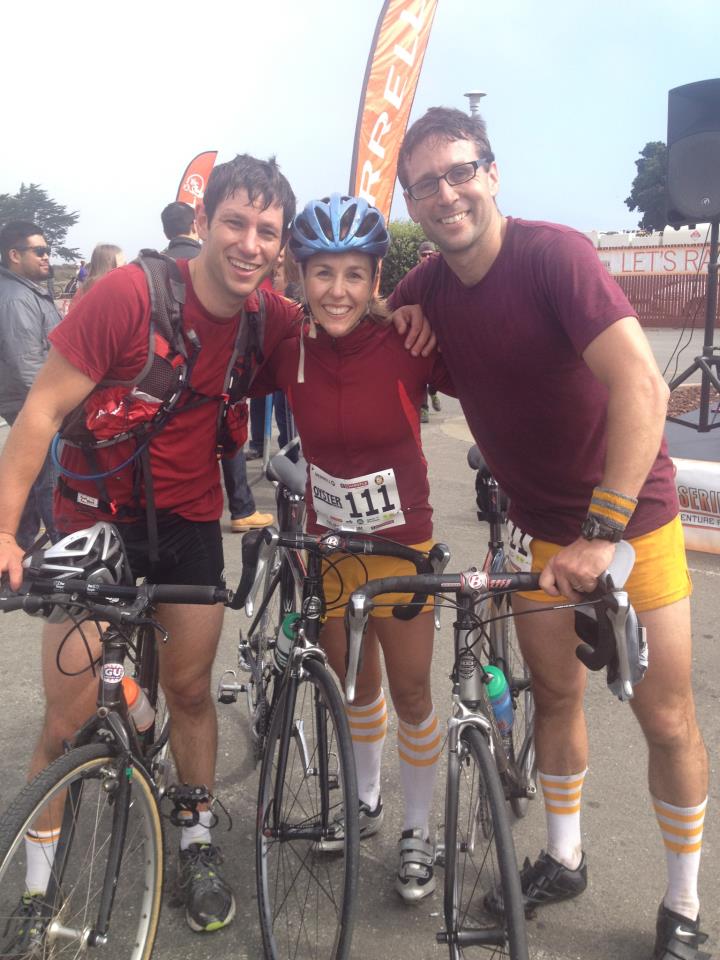
Oyster Race 2012!

Oyster Race 2012!

For some of us, exercise is fun.  Exhilarating.  Maybe even one of the highlights of our days.

But for others, it’s a chore.  Something they dread.  Maybe even something they only do under duress.  Gretchen Reynolds profiled this type of exerciser in her recent column, “When Exercise Stresses You Out,” in which she reports on a study published by scientists at UC-Boulder’s Center for Neuroscience.  The study, which was conducted on rats (who were assessed as happy or anxious), found that “even forced exercise increases stress resistance.”  This means that even if you don’t WANT to exercise, you’ll likely end up glad you did after it’s over.  The bottom line is, no matter how exercise happens…and how much you naturally enjoy the process or don’t…it IS good for you.

Now, if you’re reading this blog, you’re likely a relatively avid exerciser (or at a minimum, you like the idea of it).  So how can you get your more sedentary friends on board?  Beyond sending them this Reynolds’ article, one simple idea is to pull together a team to do a fitness event together (even people who hate exercise like fun + friends + beer at the end).  There are tons of amazing events to choose from these days, offering everything from climbing walls (Warrior Dash) to fire walking (Tough Mudder).  These team-based events are doing a great job of bringing the “hardcore” into the every day, and giving everyday (and new) athletes cool and fun ways to exercise.  Beyond the super famous ones I just mentioned, there are a few other great races out there you might want to pull a team together to try.

  •  Oyster Racing Series: One of my personal favorites, the Oyster is a team-based urban scavenger hunt including activities ranging from three legged races to kayaking to paddleboarding to finger painting…all connected by running/walking and biking.  There are full and half Oyster distances…something for everyone!
  • Rugged Maniac: A 5k obstacle course, some people call this the warm up to the Tough Mudder.  This year, participants in 21 cities across the U.S. slide down 100’ water slides, jump over fire, crawl through tunnels of mud and face a host of other challenges all while running through a combination of forests, fields, motocross tracks and ski slopes!
  • Gladiator Rock ‘N Run: I used to love watching American Gladiators on Saturday mornings…they had such cool names and were such specimens!  Founded by a real-life Gladiator, this race gives you a chance to be a Gladiator or a Goddess for a mud-filled day.

And if your friends aren’t into obstacles and mud and beer, there are tons of other options — road races, Zumba marathons, entering triathlons as a team, running relays like Hood to Coast, or even doing a day-long hike as a group (the Dipsea trail is a great one here in the Bay Area).

What events have you done with a team that you’ve loved?  Were they a good way to motivate friends to try something new?  Did they change the way you or your friends were thinking about exercise?  Please share…and just as importantly, think about what’s the next big event on your calendar!

Having MY All

I read a Pando Daily blog post a few weeks ago that really resonated.  It was about one of the media’s favorite topics these days – Sheryl Sandberg’s release of Lean In and launch of http://leanin.org/ (don’t worry, this isn’t about the raging debate about women in the workplace, I promise).  Among other great arguments, in a funny and direct and real way, author and entrepreneur Sarah Lacy doles out her own advice to young women trying to figure it all out: “don’t listen too much to any advice.”  She makes the refreshing point that each of us has a different life.  Our VERY OWN TOTALLY UNIQUE life.  We have different skills and different financial situations and different partners and different children and different challenges and different successes and different needs and different priorities.  “Having it all” does not mean the same thing to every woman (how could it? we’re not robots), so maybe the most important question to focus on is what it means for each of us to “have it all,” and what we need to do to make that happen. Read more

Virayoga Inspiration

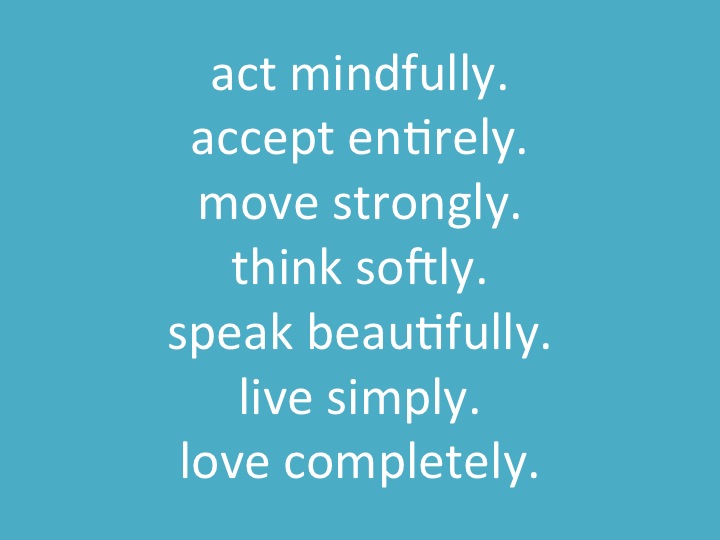
I’ve posted in the past about the power of mantra, or “a sacred utterance (syllable, word, or verse) believed to possess mystical or spiritual power. Mantras may be spoken aloud or uttered in thought, and they may be either repeated or sounded only once. Repetition of a mantra can induce a trancelike state and can lead the participant to a higher level of spiritual awareness.”  So on the three-month anniversary of starting this blog, I thought I’d post another simple one that has guided my life ever since I came across it in a Virayoga newsletter a few years ago…

virayoga quote

This simple set of phrases migrated from an e-newsletter to a post-it note to my chalkboard to a deep part of my memory where it lays the foundation for what matters most.  What mantra do you rely on?  Where did it come from, and why did it stick with you?

Healthy Cookie Monster

photo by healthaliciousness, via flickr creative commons

photo by healthaliciousness, via flickr creative commons

I’m not much of a baker.  The precision of it has always been tough for me.  But the thing is, I live with people (especially little people) who like to eat baked goods, and I think kids (and grown-ups) should have treats once in a while.  So whenever I try a cookie or muffin I really like, I ask for the recipe and file it away to make on a rainy day.  Here’s one I had recently that is relatively healthy (sans gluten, dairy, refined sugar) and totally delicious….if you like almonds, that is.  Instead of wheat flour, these cookies are made with almond flour, making them way more nutrient-dense than the cookies on the back of the Nestle bag.  I got the recipe from one of my oldest and dearest friends Erin, who eats a super clean diet (she probably washed down this cookie with a kale and spinach and cucumber juice…seriously).  With or without a green juice, these cookies had me at hello… Read more

Inspired by Travis Leach

inspireAs the quest for perspective evolves into one of the topics I seem to come back on this blog, I wanted to share an excerpt from a book I’m reading — The Power of Habit, by Charles Duhigg (great read, btw).  In his section about “The Habits of Successful Organizations,” Duhigg shares the story of Travis Leach, a now 25-year-old manager at Starbucks whose life changed after he went through Starbucks’ professional development classes.  Here’s an excerpt from the book:

“The first time Travis Leach saw his father overdose, he was nine years old.  His family had just moved into a small apartment at the end of an alleyway, the latest in a seemingly endless series of relocations that had most recently caused them to abandon their previous home in the middle of the night, throwing everything they owned into black garbage bags after receiving an eviction notice….On the morning of the overdose, Travis and his brother were playing in the living room on top of blankets they laid out on the floor each night for sleeping.  Travis’s father was getting ready to make pancakes when he stepped into the bathroom.  He was carrying the tube sock that contained his needle, spoon, lighter, and cotton swabs.  A few moments later, he came out, opened the refrigerator to get the eggs, and crashed to the floor.  When the kids ran around the corner, their father was convulsing, his face turned blue….

When Travis turned sixteen, he dropped out of high school….He got jobs at McDonald’s and Hollywood Video, but when customers were rude, he would lose control….Sometimes he’d get so upset that he would start crying in the middle of a shift.  He was often late, or he’d take a day off for no reason….When the line at his register would get too long and the manager would shout at him, Travis’s hands would start shaking and he’d feel like he couldn’t catch his breath.  He wondered if this is what his parents felt like, so defenseless against life, when they started using drugs.

One day, a regular customer at Hollywood Video who’d gotten to know Travis a little bit suggested he think about working at Starbucks.  ‘We’re opening a new store on Fort Washington, and I’m going to be an assistant manager,’ the man said.  ‘You should apply.’ A month later, Travis was a barista on the morning shift.

That was six years ago.  Today, at twenty-five, Travis is the manager of two Starbucks where he oversees forty employees and is responsible for revenues exceeding $2 million per year.  His salary is $44,000 and he has a 401(k) and no debt.  He’s never late to work.  He does not get upset on the job….’Starbucks is the most important thing that has ever happened to me,’ he said.  ‘I owe everything to this company.'” (The Power of Habit, pp. 128-130)

Maybe it was an emotional day or maybe it’s because ever since becoming a parent, I get overwhelmed when I think about the situations some kids grow up in, or maybe because it’s a beautiful success story, but Travis’s story moved me.  Here are a few thoughts it inspired:

  • Perspective: People are born into insane situations and find ways to persevere and start fresh and do amazing things.  When it feels like life is tough, or we’re not sure what to do to move forward, thinking about stories like Travis’s add perspective.  If a kid who phoned in his dad’s crack overdose at age 9 can create a life he’s proud of, anyone can.
  • Life Impacts Work and Work Impacts Life: Increasingly, I don’t believe in balance on a day-to-day basis, but I do believe in it when we consider a full lifetime.  The reality is that we don’t have work life and life…it’s all one life.  And our interests and experiences and challenges and successes in our personal spheres impact our work…and our work structure, content, community and support system impact our lives.
  • Employers Have a Huge Opportunity:  Companies can change lives by creating environments in which people can grow + thrive…just like Starbucks did for Travis.  If this happens, those people can go out into the world and change lives themselves.  Health begets health.  Healthy communities give way to healthy communities.
  • There’s More Than Meets the Eye: Everyone we meet has a story.  Each story might not be as dramatic as Travis’s, but each story matters.  And taking the time to genuinely learn people’s stories — at work, at the coffeeshop, at the hair salon, getting your oil changed, buying your groceries — can build bridges between people and helps us more deeply understand the human experience.

I sincerely believe that the more we learn about people overcoming incredible odds to find joy and success (however they define it), the harder we’ll work to get, be, and stay well.  What do you think?  Did reading about Travis make you think differently about your life, your intentions, and actions, and your opportunities?  Who has inspired you lately?

P.S. If you like the themes of perspective and perseverance, check out the story about Robert Brady I posted on my Facebook wall this week.

Warm Fuzzies

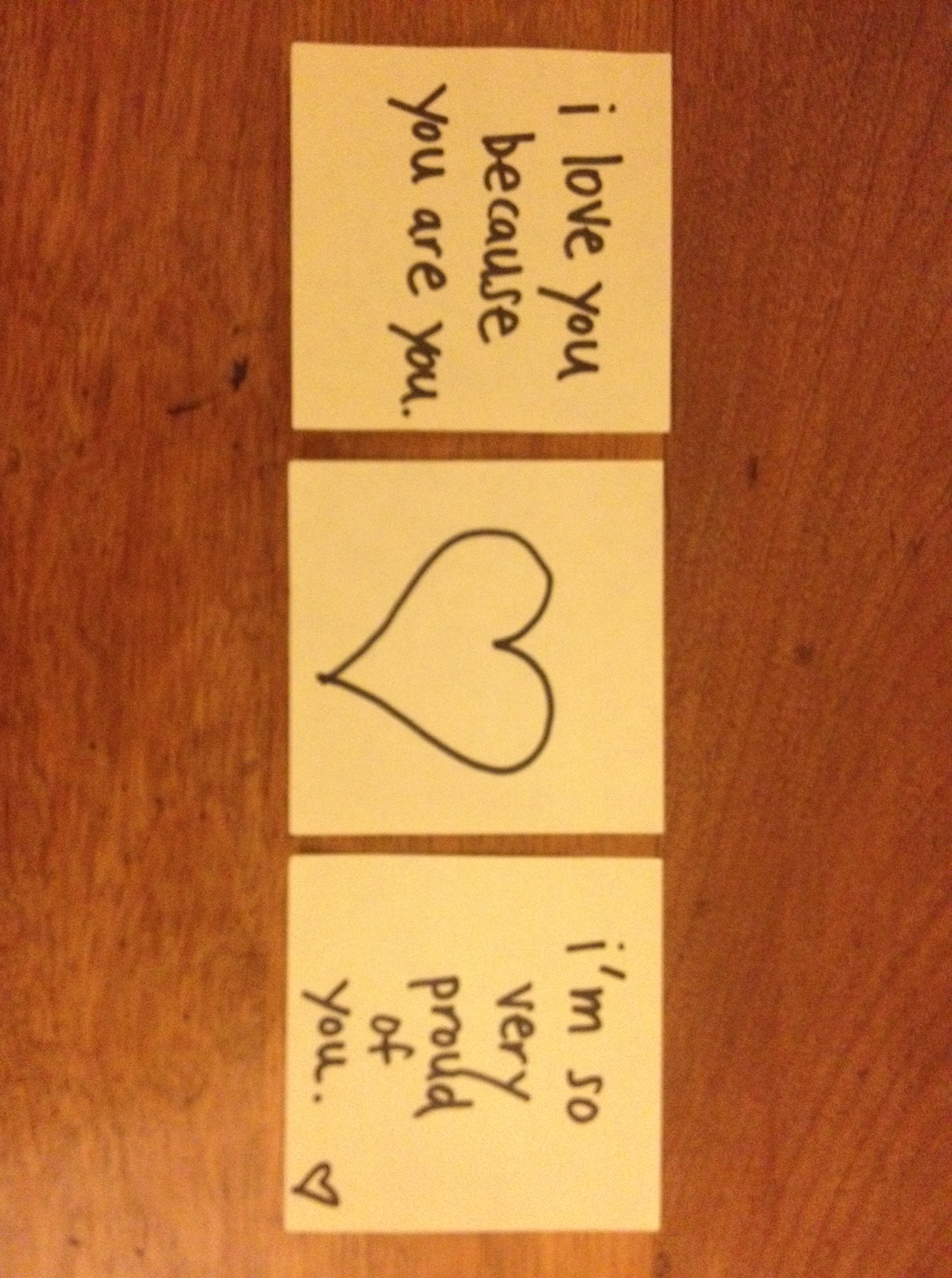
As I described in an earlier post, summer (sleepaway) camp was a formative experience for me.  It was the first time in my young life I felt truly independent.  It got me out of my sheltered world into a still-sheltered-but-not-as-sheltered place where vegetarians and musicians and people with dreadlocks and counselors with tatoos lived.  But most importantly, it reinforced that much of life’s meaning and joy comes from people and relationships and communities they form.  This focus on people wasn’t something we explicitly talked about; it was just one of the cultural norms of the camp.  It was the way people showed up every day.  One of the practical and concrete ways this manifested was overwhelmingly simple: every person in the 12-person tent taped a brown paper lunch bag onto her metal bed frame.  The purpose of the bag was to collect “warm fuzzies,” or short notes from tentmates about what makes them so awesome.  For example, warm fuzzies said things like “thank you for taking time to ask how I feel about being adopted,” or “I think you’re a beautiful singer,” or “I can’t believe you swam all the way across the lake this morning!”

I’ve thought about this exercise many times over the years, and wondered how this simple concept of proactive feedback could become more of a mainstay in our lives.  Maybe because of the warm fuzzy experience or maybe because “words of affirmation” are my leading love language*, I’ve tried to carry this through in my personal relationships.  Early in our relationship, I used to leave little handwritten love notes all over the place — in my husband’s suitcase, pocket, computer case, backpack, car, etc.  He started doing the same (maybe out of guilt, but I’ll take it), and my heart would leap when I’d find a warm fuzzy stuck on the mirror or on a bottle of juice in the fridge.  But as time has gone on and our lives have gotten more complicated, I’ve realized I barely ever do this anymore.

So in the spirit of wellness and connection and gratitude, I’m resurrecting it — for my husband and for my kids (what kid doesn’t like a love note in their lunch box once in a while).  This practice — a short message scrawled on a post-it — is for me, an easy and meaningful way to tell people I care about how awesome they are.  It can take less than a minute and can totally change someone’s day.  So if you do one thing today to support your relationships in a new way, give someone a warm fuzzy.  It might make their day — and yours — a whole lot better.

*If you’re not familiar with the concept of love languages, it can be a great relationship-building exercise.  You can learn more here.

Working Workouts into Busy Lives

In response to yesterday’s post about the need for parenting resources for the grown-up/grown-up relationships, not just grown-up/kid relationships, a few people reached out to me saying “Yes, of course parents need to take care of ourselves.  But how do we actually do it?  How do we make changes in our days and our lives that help us take better care of ourselves and our relationships?”  They’re right — the preaching is the easy part and the practice is the hard part.  For parents and for anyone else with “projects” that demand a lot of time (avid surfers, musicians, artists, volunteers, elder caregivers, etc), figuring out how to keep the self-care and relationship development pieces on the burner at all when the stovetop is really full is tough and individual, requiring thinking and intention and commitment.

I’m using this blog as a formal exploration of my quest to do this, and as I’ve been “living out loud,” I’ve become more conscious of trade-offs and more creative about working the things I need most into my days and life.  For example, in my wellfesto, I committed to “exercise as much as my time and body allow…”  How beautifully vague, right?  But this simple statement has helped me frame the role of exercise in my life from “must-run-10-miles-every-morning” to “how much time do I have for exercise and how does my body feel today?”  This simple shift has helped me let go of the rigidity that brings with it self-doubt and frustration, while reminding me that this is a top priority in my life and something I need in order to feel like myself.  Yes, a 10-mile run at 8am is still my preference, but on days when my body or schedule make that difficult, I’m OK with other, “more integrated” options.  Here are some of them:

  • Having a 15-minute dance party (including jumping, handstands, etc) with my kids after breakfast and before school/work
  • Doing walking (personal and work) meetings (you can get miles in every day just doing this)
  • Biking to and from work
  • Prioritizing a quick lunchtime workout (tabata is super efficient)
  • Jumping rope (calories burned and “high” to time ratio is incredible)
  • Simple circuit of push-ups, tricep dips, sit-ups in the morning and at night

Oh yeah, and just to add fuel to the current work-from-home fire Marissa Mayer has started, working from home is a huge help in integrating workouts (headstands in conference rooms are awkward and multiple showers per day are a waste of time and water)!  For more about this and how to integrate exercise and work, check out my earlier post on this topic.

How do you work workouts into busy days?  And how do you ensure you prioritize them on not-as-busy days?  Do you like coupling workouts with other things (work, kids, etc), or do you like them to stand on their own?

The Kids Will Be Alright

photo(11)Eight years ago, The New York Times ran Ayelet Waldman’s essay “Truly, Madly, Guiltily” in its beloved “Modern Love” column.  And all hell broke loose.  Waldman ignited the media and enraged mothers across the country with the statement that would bring her fame: “I love my husband more than I love my children.”  Read more

Diet du Jour: “The 5:2”

I’m one of the proud remaining subscribers to The New York Times.  Not just the online version, but the real paper version…the one my kids will talk about someday the way I talk the shiny red rotary phone that hung on my family’s kitchen wall when I was growing up.  Every Sunday morning after starting the coffee, I shuffle outside to grab the biggest and best edition of the week, which I proceed to religiously sort into the order in which I like to read it: Styles, Travel, Business, Review, Main, Magazine, the rest.

This was the scene yesterday, and as I plowed through the paper I came across lots of wellfesto-y articles.  Read more

Alphabet Scramble

Learning from parenting and life, while trying to get dinner on the table

The Lemonade Chronicles

A quixotic quest for the bright side.

mamajamas mom

don't sweat the baby stuff

The Development Sherpa

by SBK & Associates

wellfesto

hacking health, designing life

Rudeysroom

Rudey's Room

Building Customer Driven SaaS Products | Jason Evanish

Posts with strategies and tactics on building great products and how to be a better leader

The Blog of Author Tim Ferriss

Tim Ferriss is the author of five #1 New York Times bestsellers and host of The Tim Ferriss Show podcast.

Reflections Corner

hacking health, designing life

The Marginalian

Marginalia on our search for meaning.

Greater Good: Parenting & Family

hacking health, designing life