Skip to content

Round-Up: Five Interesting Health Stories From This Week

Marriage Reappraisal –> Marital Satisfaction (via Northwestern University News Center)

photoJust in time for Valentine’s Day, psychologists from Northwestern and Stanford published a study showing the benefits of relationship reappraisal in protecting marriages.  It sounds wonky, but the concept of reappraisal is overwhelmingly simple: it’s the ability to observe a phenomenon as if from a distance or neutral perspective.  Here’s the 21-minute (per year) intervention participants did…

Every four months for a year, participants were asked to take seven minutes to think about the biggest disagreement they had experienced with their spouse during the last four months.  They were then asked to write about it from three different angles:

  • Write from the perspective of a neutral and objective third-party who wishes to bring out the best out in the situation
  • Write about any obstacles they foresee coming up when attempting to take a neutral, third-party stance in disagreements with their partners
  • Write about how they might best go about adopting this neutral, third-party perspective in future disagreements and how this kind of perspective could help them transform disagreements into more positive experiences

And bingo, study participants reported better feelings of love, intimacy, trust, passion and commitment than their non-reappraising counterparts.  Worth 21 minutes a year?  I vote yes.

Four Workouts Might Just Be the Magic Number (via The New York Times)

photo by fang guo, via flickr creative commons

photo by fang guo, via flickr creative commons

Gretchen Reynolds from The New York Times reported on a study published this month in Exercise & Science in Sports & Medicine.  The study investigated 72 older, sedentary women and randomly assigned them to three exercise groups: 2 workouts/week, 4 workouts/week, and 6 workouts/week. While all three groups gained strength and endurance and lost body fat, the 4X/week group expended more energy (burned more calories per day) than the 2X/week group and the 6X/week group.  Why the difference?  Researchers concluded that the 6X/week participants were more likely to spend their non-exercise time sitting and resting than the other groups.  So what’s the net takeaway?  Exercise as much as you can and want to if you can keep your energy levels high through the day (avoid getting tired or slow).  But if you find yourself getting lazy after workouts, it might be worth it to dial back total weekly workouts and walk/bike/move more in your everyday life!

Marcus Antebi Aims to Own Juicing Category (via Well + Good NYC)

photo by plasticrevolver via flickr creative commons

photo by plasticrevolver via flickr creative commons

Juicing and cleansing are all the rage right now, and the founder of Juice Press, Marcus Antebi, wants to be out in front.  A former Thai boxer, Antebi has expanded from one store in New York City’s East Village in 2010 to what will be 10 by the end of this spring.  Beyond opening stores, he’s out preaching about nutrition, “saving New Yorkers from dairy-induced digestion issues and Five Guys food comas,” as Well + Good NYC reported.  He’s got big ambitions, but he’s going up against Starbucks’ Evolution Fresh.  And at $60/day, the benefits of his juice better be as loud as his marketing campaign if he’s going to own the category.

Mark Parker, CEO of Nike on Body-Controlled Music (via Fast Company)

nikeFast Company reporter Austin Carr covers Nike’s digital future in this month’s “Most Innovative Companies” issue.   Parker shares clues about how Nike will catapult out of apparel to broaden its offerings to include tech, data and services.  It’s going to encourage start-ups to build on the Nike+ platform, and if FuelBand usage continues to increase, it will have tons of data to help motivate people wearing the sleek black device.  Nike and Parker are dreaming big: “Just imagine if your body could control or change the music that you’re listening to–if your movement could actually change the cadence of the music, the tempo, or the beat.”  From my perspective, the coolest part about these goals is the potential for Nike to transform itself from a shoe company to a wellness machine.  Time will tell…

Mountain Dew for Breakfast (eeeeeew) (via Huffington Post)

kickstart-298Pepsi pushed the unhealthy breakfast to a new limit Tuesday, announcing a new breakfast drink called Kickstart.  It tastes like Mountain Dew but is made with 5 percent juice, vitamins B and C, and caffeine.  According to Pepsi’s research, the drink emerged from market research saying that Mountain Dew fans “didn’t see anything that fit their [morning drink] needs.” My take?  A little more caffeine in the shape of something real (coffee or tea) beats a can full of chemicals any day.  Just when I thought the end of soda might be nearer, it’s positioning itself at the breakfast table.  [Sigh]

This is a new type of post I’m trying out, since I find myself coming across too many interesting things during the week to cover them all in depth.  I catalogue them as I see them and then write a Friday digest.  What do you think of this format?  Helpful?  Too long?  Too short?  Too recycled?  I’d love any feedback!

Staying Healthy 30,000 Feet Up

photo by kuster & wildhaber photography via flickr creative commons

photo by kuster & wildhaber photography via flickr creative commons

I took a 14-hour flight earlier this week and am staring down the return early next.  I love flying…I love meeting random people on planes and working/reading without interruption and knowing that I’m either going somewhere or going home and realizing how amazing it is that humankind has evolved to a place where we go to sleep in San Francisco and wake up in Sydney.  But, I really don’t like sitting for hours on end, breathing stale air ,and worrying whether the water the flight attendants are serving is going to kill me.  Don’t get me wrong, the benefits of getting on planes far outweigh these little nits of mine.  But, why not optimize our flights to be the very healthiest they can be? Read more

The Alice Lane “Kibbutz”

hearts on doorstep“A deep sense of love and belonging is an irresistible need of all people. We are biologically, cognitively, physically, and spiritually wired to love, to be loved, and to belong. When those needs are not met, we don’t function as we were meant to. We break. We fall apart. We numb. We ache. We hurt others. We get sick.” 

— Brene Brown, Professor at the University of Houston Graduate College of Social Work

Sean and I drove a Penske across the country in August of 2005, making stops in exotic places like Cheyenne, Wyoming and Elko, Nevada  Our final destination was a small, dead-end street in Menlo Park California called Alice Lane, where a little apartment I had never seen awaited us and our truck full of our most prized possessions (I had been out of the country that summer, so Sean had gone solo to find a place to live).  As we drove through cornfields and across mountains – clicking off states one by one – I became increasingly curious, nervous, excited, and terrified to see this place we were going to call home for the next few years. Read more

Draw Your Life in Five Years

Slide1During my first work experience after college – an internship at the Women’s Sports Foundation in New York – an art therapist came to talk with the intern cohort about personal and professional development.  She gave us all blank sheets of paper and crayons and asked us to “draw our lives in five years.” There was no other direction – she didn’t ask us specifically to draw our work or our families or our houses…just “our lives.” Read more

Beefalo!

photo by michael filion, via flickr creative commons

photo by michael filion, via flickr creative commons

My dad introduced me to a new animal yesterday — the beefalo (a cross between 5/8 domestic cattle and 3/8 bison).  He had just learned about the mighty beefalo himself, having sat next to a part-time farmer, part-time United Airlines mechanic on a flight from Chicago to San Francisco.  The mechanic, who coincidently works in San Francisco but lives in INDIANA, has a small farm where he raises a range of animals for leisure and food.  He started breeding beefalos a few years ago and was so excited about them that he showed my dad a chart comparing the nutritional content of beefalo with beef, chicken, and fish.  This chart is the reason for this post.  Check it out:

beefalo

This stuff is so healthy!  And from what I could gather, it’s also generally sustainable and less likely than beef to be treated with antibiotics and all of the yucky stuff we don’t want in our bodies!  If you’d like to learn more, here’s a link to the American Beefalo Association’s site, as well as an article from Mother Earth News.

So…am I the only one who was in the dark about beefalo?  Have you tried it?  And if so, how did you cook it and what did you think?

365 Days of Whatever You Want: The Power of a Daily Practice

365 DaysI’m two months into my year-long project.  This translates into 43 weekdays (43 posts), meaning I’m just over 16% of the way through my experiment.  There are lots of valuable things about this project (learning new things, meeting random people from the Web, practicing writing, carving out time for myself that I otherwise wouldn’t), but the biggest benefit so far is simply having and sticking to a daily practice.  Read more

The Composite Role Model

Slide1Role models today are more accessible than ever before.  It’s easy to find and even meet people whose behavior we’d like to emulate in our own lives; and social media lets us get a real-time view into the daily thoughts and actions and struggles and achievements of people we admire.

On the flip side, as society becomes increasingly specialized and single sport athletes trump all-around performers, the idea of having one role model who “has it all” is elusive.  This has come up for me most recently as I think about the balance between career and personal/family life, as many of the people who I admire professionally have made personal trade-offs that are misaligned with my core values and world view.

To explore this area, a few months ago, I asked a successful and special friend (and role model of mine) who her role models are, and she did a great job of re-framing the question.  She told me she gave up long ago on the idea of finding one person to look up to…human beings’ personalities and values and life experiences and aspirations are simply too different to make that possible.  Instead of trying to find one person to be her north star, she looks at extreme cases, identifying the very best moms and leaders and friends and creatives she knows and trying to extract a few pieces of wisdom from each of them.

She basically creates a composite role model as part of designing her life.  This is nothing new – it’s what designers to all day long.  They observe and interview not just the everyday “user,” but the end/extreme cases too, and use all of the combined information to inform the product or experience they’re making.  But it’s not always natural to apply this principle to our lives.

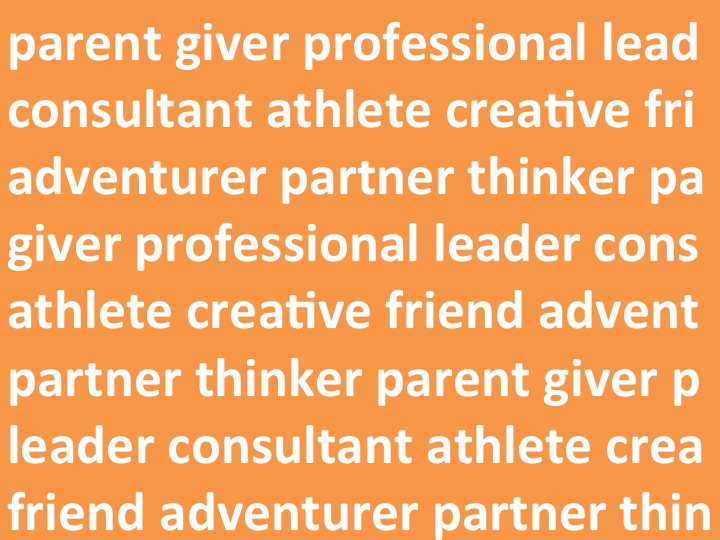
I’m now actively using the “composite view,” keep an Evernote file of “amazing people” and keeping a mental list of people who inspire me in specific areas of life.  I can then draw on examples I’ve learned from these people, and surround myself with them (virtually and physically) to give me ideas and motivation.  To name a few, I draw on my mom’s patience as a parent…I try to channel a little bit of my friend Victoria’s focus and commitment and courage as a leader…I value my dad for being a huge “giver” (of his time)…I look up to my sister Megan as a committed athlete…I (virtually) learn from Maria Popova (brainpickings.org) about what it means to be a true thinker…I’m inspired by a friend named Shiri who is on a quest to travel every inch of the globe.  Oh, and I think Obama is pretty great too.

How do you find and emulate role models?  Do you have a few who “have it all” (or most of it), or do you use the composite view?  How do role models help you shape your every day?  And have you told yours recently how awesome they are?

Living Life on Purpose

purposePeople are talking about purpose a lot these days, as bloggers and academics and coaches debate whether it’s better to actively “find your purpose” versus do things that “help your purpose find you.”  A quick web search for the term “purpose” returns an endless stream of results, including one website where I can apparently find out “how to discover my life’s purpose in about 20 minutes.”

Although it would be awesome if the purpose question could be answered in 20 short minutes on the Internet, I actually think that figuring this out – what your purpose is, what to do to find it/let it find you, and how it should and can realistically direct your life – is extraordinarily difficult and requires time and effort (I wrote a post about the early stages of my personal purpose journey a few months ago).  But there is something I think is related, yet much easier to wrap your head around and practice: living life on purpose.

In my mind, there is a significant difference between living a purpose-driven life and living life on purpose.  The former comes from a very deep place that touches the core of our being; this is my deep, deep aspiration and my individual journey, but not yet my current reality.  The latter, however, relates to things that are easier to grasp – things like reason and deliberation and goal-directedness and the ability to hold both the near-term and the long-term at the same time.  This definitely isn’t easy, but to me, it seems doable.

For me, living life on purpose is about being intentional about my actions and decisions (I’ve heard this described as disambiguation, which sounds robotic, but makes good sense to me).  Living with intention involves things like actively making trade-offs, aiming to always understand how your time is being spent and why, and putting guardrails in place to ensure you stay on track.  For example, in my wellfesto, I’ve made commitments like “I exercise as much as my time and body allow because it gives me energy and de-clutters my mind and helps me stay in the present and helps me feel like myself;” and “I prioritize my relationships with my husband, kids, family, and friends even when it means sacrifice in other areas of my life.”  These statements have very little to do with my deep, core purpose in life….but they have everything to do with living life on purpose.

I had a professor in graduate school who shared a story about how she and her partner sat down every January 1 and talked about various aspects of their lives that were going well versus not.  Something she said really stuck with me (paraphrasing here): “We know it’s impossible to optimize for everything we’d like in our lives, so we work to find a comfortable balance between things that are great and things that aren’t.  For example, we’d like to live in a warmer climate, but we love our jobs…so living in Chicago trumps moving to a warmer place.  We’d like to make more money, but we value autonomy, so we’re OK with a simpler lifestyle.”  She had incredible clarity about the trade-offs she was making and why. She was (and still is, I hope) living life on purpose.

Different people likely thrive with varying levels of intentionality about the way they live their lives.  Some may float through life happily, letting things come into and go out of their lives with little though…and that’s fine.  But others may benefit from greater attention and intention, in everyday moments, phases of their life (i.e., the roaring 20s or the mid-thirties parenting fog), or their whole life.  If you’re interested in applying the idea of intention, here are a few strategies that have worked for me:

  • Be clear about what matters most to you: Be honest with yourself and the people around you about what’s most important to you….and then design your life to maximize time around those things.
  • Actively make trade-offs: Take stock now and again of what’s going on in your life and why.  If there are things that aren’t ideal, think about them in the context of everything else.  Can you make peace with renting instead of buying a house because you don’t have the risk profile to carry a huge mortgage?  Can you live with a career plateau so you can see your kids grow up?  Or are you OK with finding someone amazing to take care of your kids so you can make a meaningful impact in your work?
  • Focus on the present: I posted earlier this week that “the way we spend our days is the way we spend our life.”  Think about where your time is going every day, and work toward a place where the way you spend most of your days reflects the way you see yourself spending your life.  I think there is a lot of value in the saying “we become what we do all day long.”
  • Ask for feedback: Talk to good friends and family now and again about whether they believe you’re walking the walk and not just talking the talk about what matters most.  Our best friends are often our most honest mirrors.
  • Be thankful.  Being able to live life on purpose is easier for some people than it is for others.  If you’re lucky enough to have the structural support, time and autonomy to be intentional about your minutes and hours and days and years, don’t lose sight of what a luxury that is.  A simple gratitude practice may push you one step further…

With or without an omnipresent purpose, not everything in life can be bright and shiny all the time.  But it’s a lot easier to accept the things that aren’t when they have been actively chosen versus decided for us.  To me, this peace of mind and clarity of thought is the greatest value of living life on purpose.

How do you feel about living your life on purpose?  Does it matter to you, or does it feel constraining?  If intention is important to you, what do you do to make sure you’re living the way you want to be living?    

Inspired by Asian Box

Menu-SlideFood inspiration can come from anywhere.  A memory of eating steaming yellow pepper and squash soup in Munich during a brief hiatus from college Eurorail madness compelled me to find a similar recipe when my garden overflowed with squash last summer.  A photo of a beautiful lunchbox assortment posted by Weelicious yesterday gave me the idea to put black beans in my kids’ lunches, breaking the monotony of sunbutter and carrot sticks.   And recently, the simple boxes my family occasionally orders from Asian Box have inspired a new way to cook healthy weeknight meals. Read more

Yoga: For You or For Them?

My yoga teacher busted out an insanely difficult pose during our Sunday morning class. It was the sort of pose that left me dumbfounded and wanting to curl up in a ball on my mat until it was over (this is essentially what I did). I don’t know what it’s called, but I just searched the web for a picture of it (below).

hard headstand

It’s a headstand with outstretched arms (not the usual hands-behind-head style); and just the sight of it terrified me that I was going to do some major damage to my neck and/or my neighbor if I attempted it. Read more

Alphabet Scramble

Learning from parenting and life, while trying to get dinner on the table

The Lemonade Chronicles

A quixotic quest for the bright side.

mamajamas mom

don't sweat the baby stuff

The Development Sherpa

by SBK & Associates

wellfesto

hacking health, designing life

Rudeysroom

Rudey's Room

Building Customer Driven SaaS Products | Jason Evanish

Posts with strategies and tactics on building great products and how to be a better leader

The Blog of Author Tim Ferriss

Tim Ferriss is the author of five #1 New York Times bestsellers and host of The Tim Ferriss Show podcast.

Reflections Corner

hacking health, designing life

The Marginalian

Marginalia on our search for meaning.

Greater Good: Parenting & Family

hacking health, designing life