Skip to content

Archive for

Nibbles and Bits

photo by steven lilley, via flickr creative commons

photo by steven lilley, via flickr creative commons

The average American wastes 1,400 calories worth of food every day.  This translates into the staggering number popularized by Jonathan Bloom, author of American Wasteland: How American Throws Away Nearly Half of Its Food (and What We Can Do About It).  According to his calculations, 40 percent of the total food we serve every day is wasted.

I grew up in the Midwest, and as a kid, the clean plate club was prized and food waste was shunned.  In fact, my mom got around the food waste issue by making “just enough” for family holidays – thereby needing to institute the FHB (family hold back) rule to make sure guests got enough to eat.  As a result of this foundation – and my inability to reconcile the fact that there is such abundance in my neighborhood while breakfast-less families wake up less than a mile away – I really, really don’t like wasting food.

But I also really, really don’t like finishing half-eaten pieces of quiche or a bowl of bacon-y brussels sprouts “just because” either.  This finishing-half-eaten-weirdness thing started when my kids began eating real food and I suddenly found myself scraping their bowls of avocado clean and eating the last pancake because it seemed easier than putting it into the fridge.  I’d end up feeling sort of full and relatively dissatisfied and disinterested in cooking anything interesting for Sean and me (we now eat mostly family meals, but some nights we still eat separately).

Knowing that wasting tons of food makes me feel guilty and eating random scraps makes me cranky, I’m trying to strike a balance: minimizing waste, but at the end of the day, opting for a little bit of waste over a scrap-based fourth meal.  This is a conscious trade-off, and every time I reach for the last few apple slices I’m really not hungry to eat, I remind myself that food should be fuel and pleasure…not obligation.  As I feed my family, I try not to forget, I’m feeding myself too.

How do you make sure you’re eating foods that make you feel like you, and honoring your meals?  How do you maximize nourishment and minimize waste?

Cheering Us On

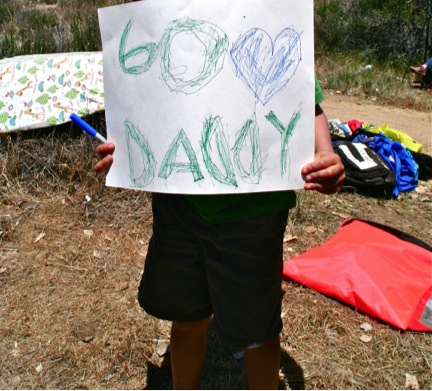
daddy sign

Girls don’t do those long races…just boys do,” my 4-yr-old son informed me knowingly as we drove out to watch my husband’s 50-mile trail (running) race this past weekend.  I asked him why he thought that, and he replied, “if girls did them, you’d be running today too, mom!

Flattered that he thought I might be an aspiring ultra-marathoner (which in case you’re wondering, I’m not) and relived that he’s not sexist, I wasn’t quite sure how to respond.  “Your dad’s insane…I’m not” didn’t feel quite right.  “I don’t want to be arthritic when I’m 45” is probably a bit over his head, I thought.  And “believe me, I’d much rather be on a trail than sitting in this car” sounded spiteful.  So I settled on the truth.  “Daddy loves these races, but I love other things.  We both spend our time doing things we love…just because we choose different things doesn’t mean they’re only for boys or only for girls.”  And on we went to the race, where we all cheered for every single “boy” and every single “girl” who came through the aid station.

My son’s question was important, both because of what he asked and what he didn’t ask.  I’ve never heard him say anything like “why is daddy spending the whole day running?  Why isn’t he with me?”  He’s never upset when I head out for a bike ride or a yoga class…in fact, I often find my kids with yoga mats outstretched — practicing their own downward dogs — when I get home from yoga.  Just as parents want their kids to be happy and free, I think kids…even little ones…want their parents to be the same.  And even more, they are watching our every move.  If we think running is cool, so do they.  If we eat asparagus, the odds go up that they’ll give it a try too.  If we play board games, they might opt for UNO over iPad.

This brings me to the next chapter of this blog.  I’m going to start focusing content more narrowly on parents, and what they can do to hack their health and design the lives they want to lead amidst the emotional and structural challenges of raising kids.  This is not turning into a parenting blog.  It’s not turning into a family blog.  It is a blog for the GROWN-UPS.  There are a ton of amazing resources out there focused on taking care of your kids and families (and I’m not trying to undermine the importance of that in any way)…but this one is about taking care of YOU.  It’s about staying connected with who you are at the core and what you care about most and what you’re working on in your life.  It’s about the constant shifting of priorities that mark these years.  It’s about the focus that brings peace, and the experiences that connect us.

I firmly believe that we can only help our kids become the best version of themselves if we are the best versions of ourselves.  And when we’re doing those things, our kids will be there to cheer us on…just as we are for them.  As I’ve said before, the kids will be alright.

P.S. If you’re not a parent, it’s my hope that you’ll still find lots of interesting ideas on this blog.  Again, it’s a blog for the grown-ups, so if your “baby” is a company or a hobby or a sport or a book or a band, I encourage you to stay tuned!

Trusting the Experts, Not the Internetz

red crossI’ve been knocked down with the stomach flu for the past few days and spent yesterday afternoon in bed foggily staring out the window, dozing off, and surfing the web.  The surfing started innocently with a relatively highbrow TED talk about what makes us love our work (feelings of forward progress and purpose), deteriorated into mindless social media scrolling, and further progressed into the worst of the worst ways to spend time on the Internet: obsessive Google searching about weird medical conditions.

I’ve always been super interested in health and remember being a little kid and loving the “Human Body” special edition of our Encyclopedia Britannica and reading my Harvard Guide to Women’s Health for fun in college.  But all of this was informational and disconnected from my own body.  It felt academic…even clinical, and it satiated my generalized curiosity versus my internalized paranoia.  It was safe, fueling my knowledge base, but not my hypochondria.

Then came the Internet, and with it, a wealth of information about health…and disease.  I love the web for the health information I can access, and I hate it for the disease information I can so easily uncover.  Yesterday was the perfect example.  I have the FLU.  The PLAIN OLD FLU.  I am certain of it.  But, concerned that my abdomen was quite sore (along with every other body part), I consulted Google “just to see” what else it might be (part curiosity, part hypochondria, part boredom).  Search terms: “vomiting, sore abdomen, fatigue.”  Google’s results: every kind of cancer you can imagine, weird bacterial infections you can only get in a far-off rainforest, ulcers ectopic pregnancy.  Rather than closing my computer as I knew I should have, I added “sore neck” to the mix, returning a slue of articles about meningitis.  I was engrossed in what could be…what might be…not what actually was.

I’d love to say this was the first time that this has happened, but that’s obviously (and embarrassingly) not the case.  When I’m honest with myself, my search history from the past year includes things like “wrist pain, toddler with short legs, neurofibromatosis, Achilles tendinitis, ankle reconstruction, dairy allergy, and kids with freckles.”  YES, FRECKLES.  Did any of this result in a diagnosis…a cure…peace of mind…or anything positive?  Of course not.  It just led to an intermittently worried mom missing out on the constant beauty and the good fortune of a blissfully healthy family.

I love the Internet for all the information and connection and power and joy it gives us…and I can’t stand the comparison, the time sucking, and the unnecessary worry that it can bring about if misused.  Just as we can set parental controls to restrict our kids’ usage, I wish we could have “crazy adult controls” to keep us from searching for weird amorphous symptoms and self cures.  In the absence of that, my resolve is to stay off the internet if I’m even slightly worried about a medical condition and leave it to the professionals….to either let it go or visit the doctor.

So with that, I’m going to go back to recovering from the PLAIN OLD FLU.  The flu that 100 years ago people would have taken at face value, simply waiting for it to pass.  The flu that will remind me (hopefully by tomorrow) how amazing it is to have a healthy body and a clear mind.  And the flu that, for better or for worse, is forcing my body to do what it probably needs…rest.

Does health information on the Internet empower you or make you paranoid?  How do you steer clear of the Web when you’re under the weather?

20 Things Wellfesto Has Taught Me About Blogging

photo by maria reyes-mcdavies, via flickr creative commons

photo by maria reyes-mcdavies, via flickr creative commons

I’ve been blogging daily for just over four months (this is my 98th post), and people often ask how it’s going.  Knowing that they’re often asking out of politeness, I usually answer with something low-risk and banal like “I’m still really enjoying it.”  Which is a 100% honest answer — I am.  But behind this, there are lots of emotions — elated, uncertain, proud, disappointed, peaceful, anxious, and vulnerable — that I only talk about if someone probes further.

The thing is — no matter what your reasons are for having a blog or any sort of publicly facing platform (and they could be anything from learning to personal growth to sharing with loved ones to wanting to become Oprah)  — it’s really hard to live your life out loud.  With authenticity comes vulnerability, with having a voice comes finding your voice, and with growing comes failing.  So today, on random day 98…still in the dawn on my wellfesto project…here are a few things blogging has taught me thus far…

  1. A daily practice is super powerful — it’s sometimes the only “me” time I get all day (even if it’s bleary-eyed “me” time)
  2. Having a daily practice means making trade-offs in other parts of life (i.e., I can’t remember the last time I read a fiction book, and my home decor leaves a lot to be desired)
  3. The simple act of making something every day is rewarding (just making something…anything)
  4. Experience and expertise aren’t the same thing, and it’s important to be clear which hat you’re wearing (or else people will think you’re selling snake oil)
  5. Just because you love to do something doesn’t mean it will be your favorite thing to write about (i.e., I love exercise, but I often feel weird writing about it because I’m not coach or personal trainer)
  6. People love recipe posts (I guess the food blogosphere is alive and well)
  7. It is nearly impossible to write with emotion about things you don’t really care about (duh)
  8. It’s easier to talk about accomplishments than failures (but failure is what makes us human)
  9. Unless people comment, blogging can feel like a 1-way street, and you need to be OK with that (here’s a hilarious post about comments, btw)
  10. It’s weird to broadcast very personal stories to strangers (thus, no sex posts yet)
  11. People like pictures as much — or more than — words (after all, we do live in the world of 140-characters + Instagram)
  12. Writing is about finding the connection between what you want to write about and what people want to read about (great tip I learned from a famous writer)
  13. People want to see the messy, difficult side of life as much as they want to see the clean, beautiful side (hmmm…misery loves company?)
  14. Blogging can deepen existing friendships and start new ones (you know who you are)
  15. Typos are inevitably (inevitable)
  16. Making a commitment out loud helps you stick to it (there is no way I’d write every day if my blog wasn’t public)
  17. You can do a lot in 30 uninterrupted minutes (uninterrupted = no email, no social media, no wiping kids’ noses)
  18. It helps to have a few posts “in the hopper” for busy days (because some days it’s easier to edit an old post than write a new one)
  19. A narrower audience makes it easier to write (stay tuned)
  20. It takes a lot of writing to become a writer

So my short answer stands: “I’m still really enjoying it.”  And for now, I’m so very happy with that.

What about you?  If you’re a blogger (newbie or seasoned), what have you learned about yourself or the blogosphere through the process?  What has been hard, and what has been amazing?  

Proudly Flexitarian

THANK YOU, Mark Bittman and Winnie Abramson, for making me feel so…normal.  A media double whammy — yesterday’s Winnie Abramson article “Why Paleo Didn’t Work for Me” and today’s Mark Bittman’s splash about his new “Flexitarian” column in The New York Times — have validated that plain, simple real food is enough of a dietary compass.  Somehow these articles have given me the courage to say goodbye to the complex I have about hating paleo — and any other sort of restriction, for that matter.

Shortly after I started this blog in December, I wrote a post about The Real Food Diet — which has been my foundational way of living and approaching food for years.  Then, after months of being knee deep in health + wellness reading, I began to question whether this simple framework was enough.  We are bombarded with information about sugar killing us, meat making us lean, meat giving us heart attacks, carbs making us cranky, etc.  Or as Mark Bittman put it in his column this morning, “And so a spectrum informs the contemporary diet: on one end is thoughtlessness; on the other, neurosis. One extreme is Morgan Spurlock’s orgy of fast food; the other is something like an ascetic diet of raw vegetables.  The first of these is not recommended. The second is almost equally extreme, almost impossible to achieve and of questionable value.”

My own self-doubt about whether my “real food” approach was good enough coincided with meeting someone who had recently finished the Whole30, a strict paleo “re-set” involving ridding your diet of all grain, sugar, legumes, dairy, and alcohol for 30 days.  He was evangelizing its impact — stable moods, boosted athletic performance, zero cravings, feeling pure and euphoric and younger and better than ever before — and he was so convincing that I bought it hook, line and sinker.  I ordered the book (which I quite liked because it doesn’t frame paleo as a diet (I’m super anti-diet), but it frames it as a way of life), got Sean on board, stocked our kitchen with coconut oil and nuts and a rainbow of fruits and vegetables, and committed to 30 days.

And the 20-something days we stuck to it (before going back to the dark side of hummus and oatmeal and wine) were…fine.  Not terrible.  Not amazing.  Not all that different actually.  Just really, really, really boring.  And annoying.  And a pain in the neck as a parent (I didn’t think it was fair to make my kids avoid dairy and grains too, so I was cooking multiple meals for dinner).  The Whole30 did re-set a few things for us: we don’t need to have a glass of wine every night with dinner, a day is complete without chocolate, always reach for veggies first and often.  And while those takeaways were important, we could have easily gotten there with plain old common sense, rather than some rigid “eat a lentil and you’ll ruin it all” plan.

Here’s the thing — I totally agree with these paleo advocates that refined, processed food isn’t good for you (obviously).  And I don’t think sugar does our bodies any favors (obviously).  But I don’t agree with limitations…I prefer choices.  I don’t want food to make me neurotic…I want it to bring nourishment and joy.  I don’t want to be the person at the dinner party who can’t eat anything being served…I want to eat from one big communal plate in the middle of the table.  I want to eat the same things as my kids.  I want to think about loved ones and dreams and ideas while I’m preparing and cooking my food…not whether my dinner is compliant.

If you want to eat paleo or vegan or fruititarian or in the zone or whatever the latest fad is, good for you.  But I have officially come full circle to thea place where I began — whole, real food.  Food that doesn’t come wrapped in plastic and doesn’t contain too many ingredients my grandmother wouldn’t have understood.  Food that I can enjoy with my whole family…with people from every corner of the globe.  Food that nourishes my body and my soul.  Like Mark Bittman, I’m standing proud as a flexitarian.  

What works for you?  How do you make sure your food is fueling you rather than zapping you of energy?  And if you have kids, do you think about their food and your food the same way?


In the Swimming Pool

photo by ian barbour, via flickr creative commons

photo by ian barbour, via flickr creative commons

I’ve been swimming a bit these days, as I have two majorly inflamed tendons in my right ankle that are limiting my workout options (and also making me VERY CRANKY).  Despite knowing that it’s great, low-impact training and having grown up splashing in lake water from sunrise to sunset, I can only seem to get myself into the pool if I’m a) injured, b) pregnant, or c) training for a triathlon (there’s obviously no “D,” all of the above given these options).  Squarely in category A and aspiring to get back into category C by summertime, the steady black line on the pool’s bottom is quickly becoming my training partner these days.

Although the act of swimming definitely feels more arduous than effortless for me, there is one thing I do really love about the sport: it’s an equalizer.  Everyone (who has been taught to stay above water) can do it in some way, shape or form…and many people can do it for a long time….even a lifetime.  My dad has been swimming a mile a day for more than 40 years, and he’s still going strong.

I first realized the equalizing power of the pool a few years ago when I was pregnant with my first child.  I captured my thoughts in a brief essay I wrote for a web essay project the design firm IDEO was running (the topic was aging).  I dug it up last night because I thought it would fit well into this post (and remind me that swimming can indeed be magical).  Here it is:

At T-minus-three days and counting until our first child is due, I’ve been spending a lot of time in the swimming pool lately.  And considering how everyone – old people, toddlers, college students, and even bored-looking lifeguards – seems to love a bulging pregnant belly, the art of making friends on the pool’s edge has been easy.  Warm smiles and friendly banter greet me as I descend into the bliss of weightlessness at lunchtime every day, and in just a few short months, I’ve been able to learn a little bit about a lot of people’s families, jobs, passions, and daily routines.  

The diversity of the lunchtime swim crowd is amazing, as people of all shapes and sizes wearing brightly colored suits and caps convene to prepare for triathlons, shed a few pounds, rehab a bum hip, relieve the stress of the workday, or simply fulfill an element of their social calendars.  In the pool, with white hair masked by swim caps and aching joints floating alongside sinewy muscles, age somehow seems to lose relevance.  As I swim steady strokes in my lane, I love the mental image of my unborn son in the same pool as an art history major, a competitive triathlete, a retired professor, and a great, great grandmother of six.    

As our society approaches an imminent and dramatic demographic shift, I think often about what sort of country my son will grow up in.  What sort of social problems will he set out to solve, and who will he look up to?  How will he view his parents and his grandparents and his neighbors? For the optimist in me, many of these answers are found in the waves of the swimming pool.  Handling this shift is about being able to co-exist with and learn from people representing a broad range of ages and backgrounds.  It’s about not caring what color the hair is underneath the cap or what stroke the person in the next lane is doing.  It’s about finding our collective strength.  Oh, and a few endorphins never hurt.

And if you’re not into essays, but you are into workouts, here’s the one I’ve been doing lately:

  • 100m freestyle followed by 15 pushups on pool deck
  • 200m freestyle followed by 15 pushups on pool deck
  • 400m freestyle followed by 15 pushups on pool deck
  • 600m freestyle followed by 15 pushups on pool deck
  • 400m freestyle followed by 15 pushups on pool deck
  • 200m freestyle followed by 15 pushups on pool deck
  • 100m freestyle followed by 15 pushups on pool deck

Are you a swimmer?  If so, were you “born or made?”  What keeps you coming back to the pool, and what’s your favorite swimming workout?

Unplugged

camping beach

This weekend’s camping trip confirmed my love/hate relationship with camping.

LOVE: sleeping close to the ground, waking up to chirping birds, feeling self-sufficient, making campfires, eating trail mix, relaxing in the late afternoon sunshine, experiencing the independence it brings out in my kids, being around fantastic, like-minded people, having easy access to amazing natural beauty (in this weekend’s case, the beach), wearing bright colors, UNPLUGGING

HATE: eating out of a cooler, finding dirt in my sleeping bag, finding dirt in my pockets, finding dirt in my food, finding dirt behind my ears, shivering in the morning, using communal toilets, seeing one too many raccoons, dealing with SO MUCH GEAR (although Sean deals with it, so this shouldn’t really be on this list)

Thankfully — both because Sean has a love/love relationship with camping and because it’s Earth Day today — the LOVE list is longer than the HATE list.  Yes, we will indeed camp again, and I can now refer to this list whenever I’m feeling cranky about the cold and the dirt.  And while all of the things on the LOVE list are important to me, the one that’s extra special because it’s hardest for me to achieve in my normal (electricity + running water filled) life is the ability to unplug.

I didn’t open my computer (and minimally used my phone) from noon Friday until this morning, and it felt purifying and empowering.  I know this is a ridiculous thing to be so proud of — 2.5 days sans computer — but the reality is, it rarely happens.  And even in a short time, it’s amazing how connected I felt to my family and how much I didn’t even miss my steady information diet.

I did a bit of research about unplugged weekends this morning, and found out there is actually a National Day of Unplugging.  I’m sure I was surfing some random website during this year’s celebration, but I’m marking my calendar for next year’s shebang, March 7-8, 2014.  I also found a good article published on Huffingtonpost.com making a pretty good case for unplugging.  It’s no surprise, but here are five reasons to steer clear of screens.  They…

  • Limit Ability to Pay Attention: Called “popcorn brain,” chronic Internet users often report having a tougher time focusing and tuning out irrelevant material
  • Increase Stress: This is more for heavy social media users suffering from the evil comparison that social media usage can provoke  
  • Disrupt Sleep: Screens actually emit a blue wavelength of light that tricks the brain into thinking it’s time to be alert…yet 95% of Americans report using some sort of screen in the hour before bed
  • Stunt Creativity: Screen-free time in nature has been shown to boost creativity though.  All the most reason to turn off the screen get outside!
  • Hurt: Yes, sitting is killing us slowly

I opened my trusty MacBook Pro this morning feeling bright-eyed and clear-headed, not anxious or already behind.  Pretty good ROI for just 2.5 days off.  Now the challenge is to make this happen whether I’m sleeping in the wilderness on the weekends or not!

How do you unplug?  Do you notice real emotional and physical changes when you get away from your screens and out into nature?   

A few thoughts for the weekend…

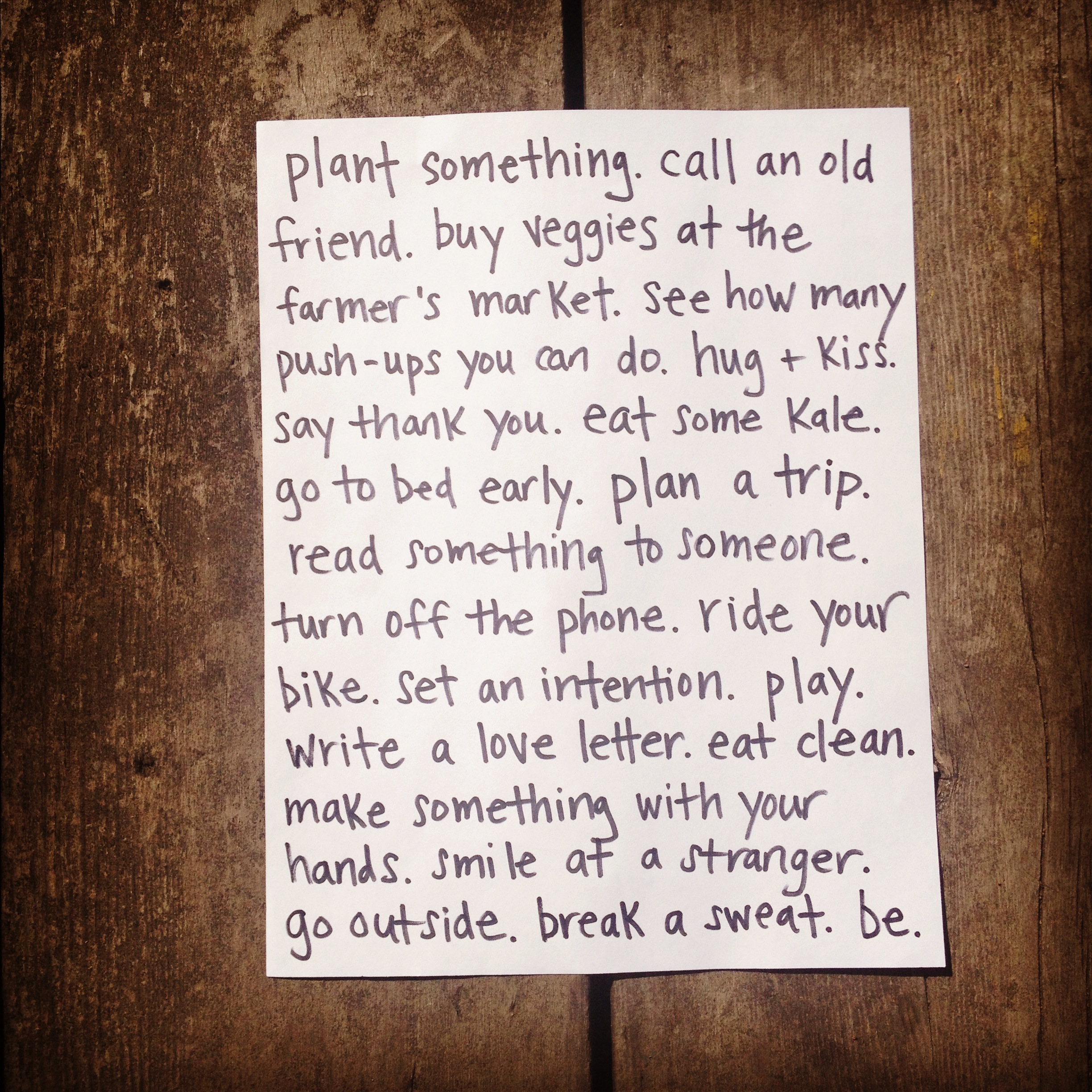
After a week filled with tragedy, may this weekend bring us all rejuvenation and connection and peace and health.  Here are a few simple ideas for taking care of your body, mind and spirit…

weekend wellfesto

Morning Reading

photo by NS newsflash, via flickr creative commons

photo by NS newsflash, via flickr creative commons

My first job out of college was at a PR firm, and I learned lots of lessons that have stuck with me.  I learned that crying at work is more than OK — it reinforces our humanity and can actually build bridges.  I learned to treat clients with “a little more sugar and a little less vinegar,” as my boss freely told me.  I learned that people actually like when you show your true colors.  I learned that bad ideas sometimes lead to the best ideas.  And I learned to always read the morning headlines.

The principals of the firm were emphatic about the importance of never being caught off guard by a client and often asked us about random news events to make sure we’d at least skimmed the main papers that day.  They believed in the value of connecting different areas (health + tech + politics + fashion, etc) in order to generate ideas and deeply understand the societal trends in which our clients’ businesses functioned.  I’ve found this to be true not just in PR, but in every job and any relationship I’ve ever had.  Being in the know helps.  And more importantly, it’s fun and expanding and funny and sad and human.

I love this lesson  because I feel like it’s given me a lifelong license to do something fun and personal (read about mainstream AND weird stuff) in the spirit of work.  Today’s reality is that fun + personal + work are becoming increasingly intertwined, so this now feels more natural than it did 10 years ago.

So how does this look for me?  Simple.  I try to read every morning for 30 minutes or so over breakfast before diving into the day.  I get most of my news via Facebook, Twitter and LinkedIn feeds, and I also read a few newsletters that I think have great variety:

How about you?  Do you spend focused time reading every day, and if so, what blogs/newsletters/papers/magazines that you love and couldn’t get through your day without?  

P.S. If you want to justify your social media habit at work, here’s a great article linking social media use and productivity!

Fit Parents

photo (2)

A few months ago, someone saw me running my kids to school in the stroller and said,”I can’t believe you’re still exercising.  I gave that up once I had kids.”  I wanted to say, “Oh really, did you stop breathing too?”

This person unfortunately seems to be not an outlier, but the norm.  According to a 2010 Gallup study, among Americans aged 18-50, those with children at home are less likely to report frequent exercise than their childless peers.  And parents who have a child younger than four report lower levels of frequent exercise (24.5%) than their fellow parents with older kids (25.7%).  Not surprisingly, parents are also slightly more likely than those without children to be overweight or obese.

Here’s the thing: without a doubt, becoming a parent (or starting anything else that requires a ton of time and energy) puts constraints on when and for how long you can work out.  It’s damn hard to fit it in some days.  But my (admittedly harsh) point-of-view is that people who don’t exercise when they have kids (but still claim they want to) haven’t stopped because of the kids themselves; they’ve quit because they have consciously or unconsciously decided that workouts are no longer a priority in their life.  I should note here that there’s a whole separate group of people who never made exercise a priority pre-kids, and therefore face the challenge of starting a new habit in a very busy phase of life (this post is targeted more to group #1).

My message here is for the parents out there who aren’t exercising, but WANT to be.  It IS possible.  And worth it…after all, shouldn’t taking care of ourselves be at the top of the list once we have kids — maybe even higher than it was before?  Being good to our bodies gives us the energy to play with our sweet little rugrats and improves our odds of living to see them grow up.  Choosing a workout over morning TV sets a good example, making cycling or swimming or yoga seem cooler than Dora the Explorer.  And moreover, exercise is a way to get time on your own or with loved ones to rejuvenate and release stress and re-connect.

So if you have kids, are thinking about having them, or have a loved one who has them — and you’d like to keep exercise in your life — here are a few simple ideas to keep in mind.

  • Find something you love to do.  Similar to the way Sheryl Sandberg argues that it’s important for people to find a career they’d want to return to after having kids, I think it’s important for people to find a workout (or ideally lots of kinds of exercise) they love before having kids.  After all, it’s a lot easier to continue a habit than it is to try to create a new one…especially in the whole new world of parenting.
  • Create ways to exercise as a family.  Workouts don’t have to mean time away from kids.  Two ways we integrate our kids into our exercise time are 1) running with stroller + bike, and 2) going to the track to run intervals while our kids play in the grassy area in the middle.
  • Do a Saturday morning handoff.  Sometimes I’ll go to yoga early in the morning while my husband hangs out with the kids.  He’ll then bring the kids to the studio, I climb into the driver’s seat and he heads into the yoga studio for his class.  This is a popular one for parents who have the luxury of a partner with whom to share parenting duties.
  • Try a pre-dawn workout.  Yes, it’s painful, but it’s possible.  And it’s a surefire way to get a workout in while the munchkins are still deep in sleep.
  • Integrate exercise into your everyday.  Exercise doesn’t have to leave you a sweaty mess.  Sometimes the most effective way to work it in is to try smaller increments during the day.  Walk to the park instead of driving…bike to work…dance after breakfast…stretch before bed.  Make exercise a lifestyle rather than an event.

I love my family more than anything in the world, but I also know what I need to do to be a great mom and partner.  And for me, getting a regular workout is and always has been a non-negotiable.  And my kids are more than alright.

How about you?  If you have kids — or a thriving hobby or anything else that takes a disproportionate amount of time — how do you fit in workouts?  Do you like to work out with your family, or is it your precious solo/grown-up time?  And if you’re not fitting it in, but want to, what small changes can you make to make room?

Alphabet Scramble

Learning from parenting and life, while trying to get dinner on the table

The Lemonade Chronicles

A quixotic quest for the bright side.

mamajamas mom

don't sweat the baby stuff

The Development Sherpa

by SBK & Associates

wellfesto

hacking health, designing life

Rudeysroom

Rudey's Room

Building Customer Driven SaaS Products | Jason Evanish

Posts with strategies and tactics on building great products and how to be a better leader

The Blog of Author Tim Ferriss

Tim Ferriss is the author of five #1 New York Times bestsellers and host of The Tim Ferriss Show podcast.

Reflections Corner

hacking health, designing life

The Marginalian

Marginalia on our search for meaning.

Greater Good: Parenting & Family

hacking health, designing life