Skip to content

Posts from the ‘Eat’ Category

Eat Local

Even though I now live in a place where “summer” extends far beyond the short window when schools close and summer camps open, I still love the way Memorial Day marks the unofficial (pre-solstice) beginning of the season of long days…meals outside…sweaty workouts…family downtime…new top 40 hits…bare skin…BBQs…beach reads…skinny dipping…s’more making…fireworks…nostalgia…FUN!  To kick off the season, I’m going to make a special trip to the farmer’s market this Sunday to stock the kitchen with seasonal deliciousness (something I’m trying to do more consistently).  If you’d like to do the same, Field to Plate offers a comprehensive list of farmer’s markets around the U.S.  Happy (and healthy) eating this weekend!

On a related note, I need some new food inspiration.  Do you follow a food blog the inspires you to cook great, seasonal dishes?  I’m thinking about trying out a few of Saveur’s 2013 Best Food Blog winners, but I’d love recommendations!

poster by my-name-is-annie via deviantART

poster by my-name-is-annie via deviantART

Refrigerator Cleanout

photo by bobbi bowers, via flickr creative commons

photo by bobbi bowers, via flickr creative commons

Growing up, I remember eating some weird meals in the name of “refrigerator/freezer cleanout.”  Bless my practical and wonderful Midwestern mother who taught by example that we shouldn’t waste a bite, eating a smorgasbord of leftovers or an unexpected combination of sausage, broccoli and peaches (or something like that) was never out of the question.  (Note: the saving grace of these meals was that they were likely to be eaten by candlelight).

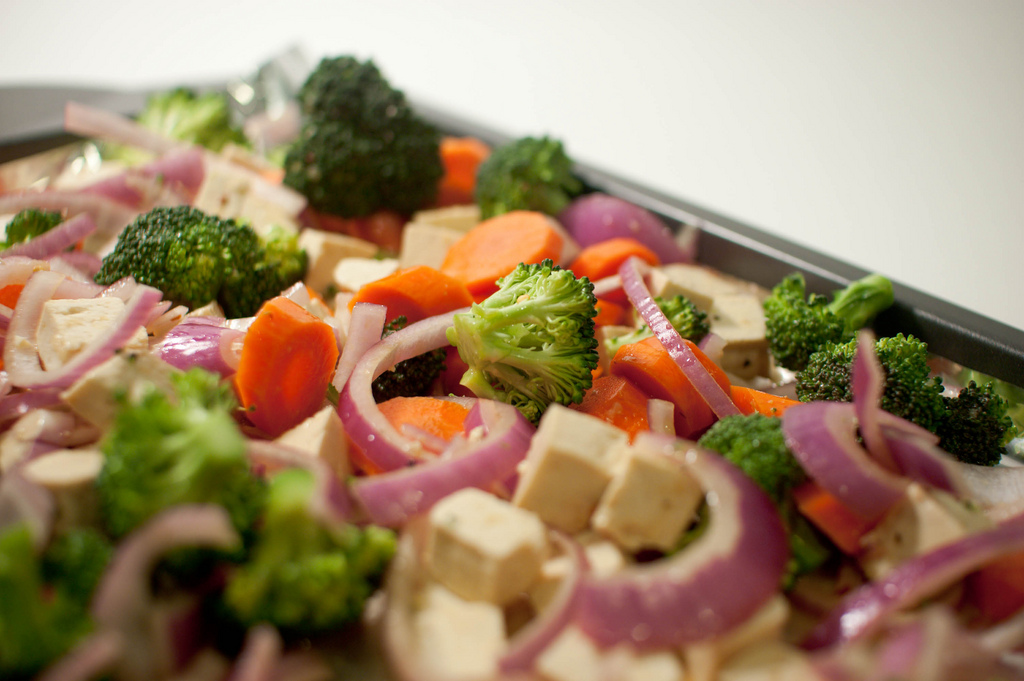
In my adult life, I have trouble putting together these random meals (in part because I married and share meals with a man who rarely ate leftovers when we met).  But nonetheless, I inherited my mother’s practicality and like the idea of putting what I have in the fridge to good use.  I made my favorite fridge cleanout meal last night: stir-fry.  I’m sure real chefs would cringe to hear me talk about the prized stir-fry as my “cleanout meal,” but I’m not a real chef.  I’m just a human trying to put colorful, real, nutrient-dense food into my body via meals that look pretty and taste good enough to make mealtime pleasurable.  So if you’re in the same boat as me, here’s the version of the stir-fry I made:

  • Saute garlic, ginger, and red onion in sesame oil
  • Add 2 diced carrots, a handful of sliced mushrooms, a head of broccoli chopped into small pieces, spinach leaves, leftover chicken broken into small pieces
  • Drizzle soy sauce as cooking veggies and warming chicken in wok
  • Add leftover cooked brown rice
  • Mix in one scrambled egg per person
  • Add spice with a drizzle of sriracha sauce as desired

This took 10-15 minutes to make and tasted hearty and whole and real and (dare I say) interesting.  I even had seconds….in honor of my mom.

What’s your go-to refrigerator cleanout meal?  And if you’re not into using whatever scraps you have, what’s a delicious and super fast meal you’ve cooked lately? 

Breakfast Inspiration: Steel Cut Oats

photo by stacy spensley, via flickr creative commons

photo by stacy spensley, via flickr creative commons

We all need an effortless morning once in a while (says the girl writing a blog post at 11pm), and having steel cut oats for breakfast is one of my favorite ways to ease into the day.  If you’re looking for a new idea — or a new take on an old one — prep your steel cut oats the night before, so all you need to do is heat them up after you start the coffee!  And if you’re like me and wondering if steel cut oats are any better for you than regular old Quaker oats, the answer is…no.  Both stack up the same, from a health and an environmental perspective.  But from a yumminess perspective, I vote for steel cut all the way…ideally topped with blueberries, slivered almonds, and a touch of honey.

How do you like yours?  Do you have any ninja breakfast secrets that make your mornings easy and delish?

Dinner Al Fresco

view from the picnic table, elizabeth gamble gardens, palo alto

view from the picnic table, elizabeth gamble gardens, palo alto

We’re in the midst of a surprise heat wave here in Northern California, boasting 80+ degree days for the last few weeks.  Within a matter of days, I packed up my tall boots and busted out my sandals, started sleeping with the windows open at night, wanted to bike everywhere, and began eating dinner outside again.

There’s something magical about eating outside.  Similar to the way candlelight helps us savor and honor our food, eating with our feet in the grass helps us slow down.  Food seems to taste better, the evening light makes people look extra beautiful, and the stress of the day washes away more quickly.  We’re less likely to use our phones.  We’re more playful.  We’re nicer to each other.  We feel healthier.  Dinners last longer than five minutes.  And the grown-ups don’t need to get on our hands and knees to scrape mashed veggies off the floor when we’re finished eating (BONUS)!

Tonight before we even started cooking, the kids said “can we please eat outside tonight…can we please eat outside every single night from now until forever?”  They put words to what I was feeling.  In this case, we’re all on the same page.  The kids and the grown-ups want the very same, simple, universal pleasure: dinner al fresco.

What’s your favorite meal to make when you’re eating outside?  And if you can’t eat outside at your home, where do you love to go? (The photo above is one of my favorite spots to eat takeout on a picnic bench while literally, smelling the roses.)

Nibbles and Bits

photo by steven lilley, via flickr creative commons

photo by steven lilley, via flickr creative commons

The average American wastes 1,400 calories worth of food every day.  This translates into the staggering number popularized by Jonathan Bloom, author of American Wasteland: How American Throws Away Nearly Half of Its Food (and What We Can Do About It).  According to his calculations, 40 percent of the total food we serve every day is wasted.

I grew up in the Midwest, and as a kid, the clean plate club was prized and food waste was shunned.  In fact, my mom got around the food waste issue by making “just enough” for family holidays – thereby needing to institute the FHB (family hold back) rule to make sure guests got enough to eat.  As a result of this foundation – and my inability to reconcile the fact that there is such abundance in my neighborhood while breakfast-less families wake up less than a mile away – I really, really don’t like wasting food.

But I also really, really don’t like finishing half-eaten pieces of quiche or a bowl of bacon-y brussels sprouts “just because” either.  This finishing-half-eaten-weirdness thing started when my kids began eating real food and I suddenly found myself scraping their bowls of avocado clean and eating the last pancake because it seemed easier than putting it into the fridge.  I’d end up feeling sort of full and relatively dissatisfied and disinterested in cooking anything interesting for Sean and me (we now eat mostly family meals, but some nights we still eat separately).

Knowing that wasting tons of food makes me feel guilty and eating random scraps makes me cranky, I’m trying to strike a balance: minimizing waste, but at the end of the day, opting for a little bit of waste over a scrap-based fourth meal.  This is a conscious trade-off, and every time I reach for the last few apple slices I’m really not hungry to eat, I remind myself that food should be fuel and pleasure…not obligation.  As I feed my family, I try not to forget, I’m feeding myself too.

How do you make sure you’re eating foods that make you feel like you, and honoring your meals?  How do you maximize nourishment and minimize waste?

Proudly Flexitarian

THANK YOU, Mark Bittman and Winnie Abramson, for making me feel so…normal.  A media double whammy — yesterday’s Winnie Abramson article “Why Paleo Didn’t Work for Me” and today’s Mark Bittman’s splash about his new “Flexitarian” column in The New York Times — have validated that plain, simple real food is enough of a dietary compass.  Somehow these articles have given me the courage to say goodbye to the complex I have about hating paleo — and any other sort of restriction, for that matter.

Shortly after I started this blog in December, I wrote a post about The Real Food Diet — which has been my foundational way of living and approaching food for years.  Then, after months of being knee deep in health + wellness reading, I began to question whether this simple framework was enough.  We are bombarded with information about sugar killing us, meat making us lean, meat giving us heart attacks, carbs making us cranky, etc.  Or as Mark Bittman put it in his column this morning, “And so a spectrum informs the contemporary diet: on one end is thoughtlessness; on the other, neurosis. One extreme is Morgan Spurlock’s orgy of fast food; the other is something like an ascetic diet of raw vegetables.  The first of these is not recommended. The second is almost equally extreme, almost impossible to achieve and of questionable value.”

My own self-doubt about whether my “real food” approach was good enough coincided with meeting someone who had recently finished the Whole30, a strict paleo “re-set” involving ridding your diet of all grain, sugar, legumes, dairy, and alcohol for 30 days.  He was evangelizing its impact — stable moods, boosted athletic performance, zero cravings, feeling pure and euphoric and younger and better than ever before — and he was so convincing that I bought it hook, line and sinker.  I ordered the book (which I quite liked because it doesn’t frame paleo as a diet (I’m super anti-diet), but it frames it as a way of life), got Sean on board, stocked our kitchen with coconut oil and nuts and a rainbow of fruits and vegetables, and committed to 30 days.

And the 20-something days we stuck to it (before going back to the dark side of hummus and oatmeal and wine) were…fine.  Not terrible.  Not amazing.  Not all that different actually.  Just really, really, really boring.  And annoying.  And a pain in the neck as a parent (I didn’t think it was fair to make my kids avoid dairy and grains too, so I was cooking multiple meals for dinner).  The Whole30 did re-set a few things for us: we don’t need to have a glass of wine every night with dinner, a day is complete without chocolate, always reach for veggies first and often.  And while those takeaways were important, we could have easily gotten there with plain old common sense, rather than some rigid “eat a lentil and you’ll ruin it all” plan.

Here’s the thing — I totally agree with these paleo advocates that refined, processed food isn’t good for you (obviously).  And I don’t think sugar does our bodies any favors (obviously).  But I don’t agree with limitations…I prefer choices.  I don’t want food to make me neurotic…I want it to bring nourishment and joy.  I don’t want to be the person at the dinner party who can’t eat anything being served…I want to eat from one big communal plate in the middle of the table.  I want to eat the same things as my kids.  I want to think about loved ones and dreams and ideas while I’m preparing and cooking my food…not whether my dinner is compliant.

If you want to eat paleo or vegan or fruititarian or in the zone or whatever the latest fad is, good for you.  But I have officially come full circle to thea place where I began — whole, real food.  Food that doesn’t come wrapped in plastic and doesn’t contain too many ingredients my grandmother wouldn’t have understood.  Food that I can enjoy with my whole family…with people from every corner of the globe.  Food that nourishes my body and my soul.  Like Mark Bittman, I’m standing proud as a flexitarian.  

What works for you?  How do you make sure your food is fueling you rather than zapping you of energy?  And if you have kids, do you think about their food and your food the same way?


3-Ingredient Meals

photo by cookbookman17, via flickr creative commons

photo by cookbookman17, via flickr creative commons

One winter break during college (long before all of today’s talk about clean eating), I arrived at my parents’ house to find my mom cooking “three-ingredient meals.”  She’d randomly picked up a cookbook called Cooking 1-2-3: 500 Fabulous Three-Ingredient Recipes, and she was hooked on the idea of whipping up delicious and simple meals using minimal ingredients.  While I was pretty sure I was already on to the idea of simple ingredients (the beer/cheese/peanut combo counts, right?), I decided I might have something to learn from her earnestness and experience.  So we cooked…and we cooked…

And while I don’t remember exactly what we made or how we did it, I do remember the amazement that such deliciousness could erupt from such simplicity.  Simple grilled or broiled fish with a salad…pureed vegetables offering a creamy foundation for a pork chop or piece of beef…tempeh and broccoli stir-fry…pudding!  So now, as I try to cook healthy meals for a family (with limited time and equally limited culinary skill), I often fall back on the 3-ingredient framework (I don’t include spices or oils in my 3 ingredients).  Here are some of my favorite recipes to make:

Yes, three ingredients is limiting, but sometimes limits actually provide comfort and ease.  And beyond that, in the food category, if you can pronounce and recognize everything you’re eating, you’re better off than most people!

Do you have any favorite 3-ingredient dishes to share?  Does limiting ingredients help you cook easier, healthier food, or does it leave you feeling unsatisfied?  If not 3, what’s your magic number?

Five Ways to Drink More Water

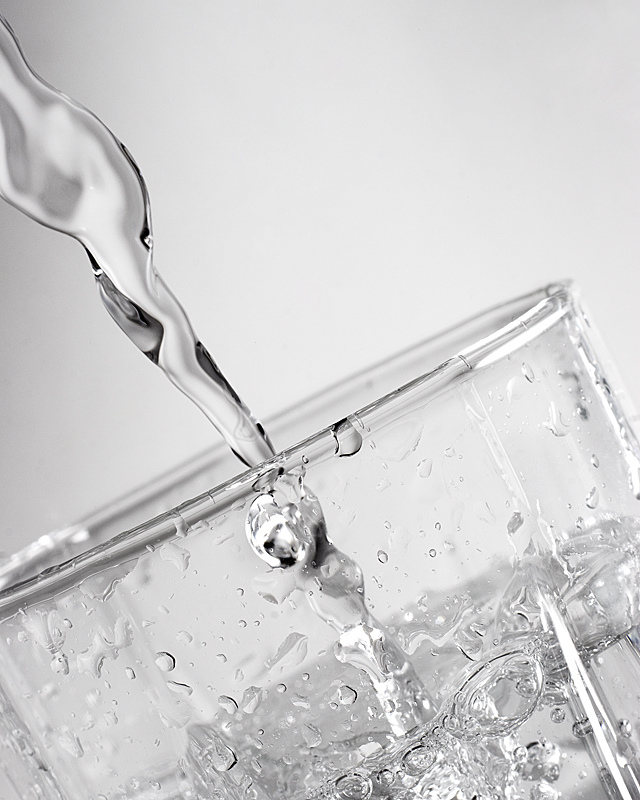
water glassAn infographic comparing water and Coke was circulating the web earlier this week.  When I did some digging, it sounds like the info about Coke (which was SUPER DISTURBING) contained some inaccuracies, so I’m not re-posting it here.  What I am posting here, however, are the statistics about water:

  • 75% of Americans are chronically dehydrated
  • In 37% of Americans, the thirst mechanism is so weak that it is often mistaken for hunger
  • Even MILD dehydration will slow down one’s metabolism as much as 30%
  • One glass of water will shut down midnight hunger pangs for almost 100% of the dieters studied
  • Lack of water is the #1 trigger of daytime fatigue
  • Preliminary research indicates that 8-10 glasses of water a day could significantly ease back and joint pain for up to 80% of sufferers
  • A mere 2% drop in body water can trigger fuzzy short-term memory, trouble with basic math, and difficulty focusing on the computer screen or on a printed page

This is not new news.  We are told from little on that “eight glasses a day keeps the doctor away,” and for me, water consumption is a great example of the reality that information does not equal behavior change.  I know that most days I don’t drink enough water, and my excuses are endless: I feel nauseous when I drink water on an empty stomach…I feel too full when I drink it with my meals…I don’t like it sloshing around in my stomach during workouts…I race from workout to shower without taking the time to drink…it’s BORING…

So I’m working on this.  Really working on it.  Trying to put structures and incentives in place to get myself to drink enough water to keep my brain clear and my energy up.  Here are a few things that are helping:

  • SodaStream: I like fizzy water much more than plain old boring water, so our at-home carbonator is a huge help.  I usually mix 80% water with 20% juice to make the drink more appealing
  • Emergen-C: Vitamin C + a little bit of flavor helps the medicine go down
  • Tea: A mid-afternoon glass of decaffeinated tea is hydration I can look forward to.  My favorites are ginger and licorice root
  • Workout Hydration: I am trying to make my water bottle just as important as my ipod during workouts.  This is obviously a no brainer, but more easily said than done
  • 8oz Before Bed: I find that I sometimes wake up thirsty, and drinking a full glass of water before bed helps.  Plus, the more I do it, the more it becomes a habit!

Might you be chronically dehydrated?  If so, what are you doing to guzzle more (and ideally enjoy it)?

Weekly Menu

menuA few years ago, Sean and I spent a totally, ridiculously disproportionate amount of time at the grocery store.  We went 3-5 times/week because we were never very thoughtful about what we bought and how it related to what we might want to cook that week.  While some people can whip up something amazing using whatever’s in the fridge, we’re not those people.  We can cook, but we need a plan….and we’re better off if we have a recipe.  So finally, after having our second child and realizing that hauling two kids to the grocery story multiple times each week wasn’t sustainable or fun, we started putting together a weekly menu.  It takes some work, but a weekly menu has cut our shopping time, saved us money, taken away the stress of trying to figure out what to make every night, and better allowed us to share responsibility for feeding our family.  Oh, we don’t eat bread, cheese, salad and wine every single night for dinner anymore.

So how does this work?  Here’s our system:

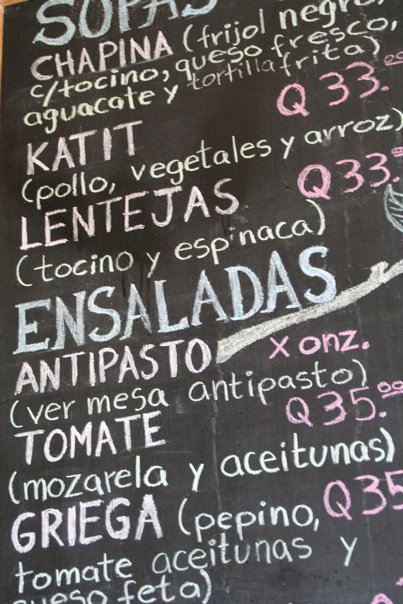
  • Saturday or Sunday, one of us takes the lead on planning a menu for that week.  We plan four meals, assuming that we’ll either eat out or eat leftovers one night during the week.  We have a chalkboard in the kitchen where we write down what’s on the menu each day of the week
  • We survey what’s in the fridge and make a list of what we’ll need for that week’s meals and then divide the list by what we need to get at Trader Joe’s versus Whole Foods versus the farmer’s market (I know, this isn’t very efficient, but unless Trader Joe’s starts sourcing better produce and meat, we’ve got to do it)
  • We prep what we can (cutting veggies, washing lettuce, etc on the weekend) when we can.  I wish we were better about this, but takes commitment
  • We keep any recipes we’re using in a recipe box at Epicurious.com (I’m sure there are lots of organizers out there, but this is the one we started using, so now it’s tough to switch)
  • We make family meals.  If the kids don’t want to eat salmon, tough luck.  It’s difficult enough to make one meal at night, much less two!
  • We stick to our menu (for the most part)!  And having a fallback go out/eat leftovers/make eggs option takes the pressure off

So what’s on the menu this week?

  • Mon – off the hook (going out with friends)!
  • Tues – roasted chicken thighs with carrots and sweet potatoes, green salad
  • Weds – broiled salmon, rice pilaf, green salad
  • Thurs – chicken, broccoli, and red pepper stir-fry
  • Fri – asparagus/leek soup (in the Vitamix), grilled sausage, green salad

What’s your system for cooking at home in as little time as possible?  Do you have a few “go-to” menus?  Do you prep everything on the weekend?  Do you trade off meal duty with your partner?  And if you have a weekly menu to share, please send or post it, as I’m always looking for ideas!

Hungry or Craving?

photo by la grande farmers' market, via flickr creative commons

photo by la grande farmers’ market, via flickr creative commons

I recently read a tip about diagnosing cravings that has changed the way I think about food (hasn’t fully changed my behavior, but it’s definitely made me much more aware of my choices).  In their bestseller, It Starts with Food, Whole30/Paleo enthusiasts Dallas and Melissa Hartwig suggest asking yourself a simple question when you’re trying to figure out if you’re truly hungry or just craving something:

“Am I hungry enough to eat steamed fish and broccoli right now?” 

If the answer is no, then you’re not really hungry; you’re craving.  When this happens, the authors suggest doing something other than snacking (going for a walk, calling a friend, drinking a glass of water are all good options).

Now, these guys are the hardest of the hard core in the eating department — eating a diet free of grains, sugar, legumes, dairy and alcohol — not just for the 30 days their book advocates, but for life.  We’re not all going to eat like them, but as with anything else, we all can learn from them.  We can take little pieces  (or big pieces) of wisdom from their program and incorporate it into our lives.

The steamed fish and brocoli visualization is one of the pieces I’ve borrowed, and I come back to it each day when I find myself reaching for a piece of fruit or handful of almonds or steaming bowl of oatmeal (my comfort snack) or piece of chocolate.  Sometimes I stare at that plate in my mind and still choose to indulge my “craving,” but I do it less than I used to, and when I do, it’s a conscious decision, not a mindless act.

What tips have you picked up from friends or experts that have changed the way you eat?  Do you subscribe to ideas from one nutrition “guru,” or do you pick and choose to customize your own plan? 

Alphabet Scramble

Learning from parenting and life, while trying to get dinner on the table

The Lemonade Chronicles

A quixotic quest for the bright side.

mamajamas mom

don't sweat the baby stuff

The Development Sherpa

by SBK & Associates

wellfesto

hacking health, designing life

Rudeysroom

Rudey's Room

Building Customer Driven SaaS Products | Jason Evanish

Posts with strategies and tactics on building great products and how to be a better leader

The Blog of Author Tim Ferriss

Tim Ferriss is the author of five #1 New York Times bestsellers and host of The Tim Ferriss Show podcast.

Reflections Corner

hacking health, designing life

The Marginalian

Marginalia on our search for meaning.

Greater Good: Parenting & Family

hacking health, designing life