Skip to content

Posts from the ‘Work’ Category

No Boundaries

photo by ex-smith, via flickr creative commons

photo by ex-smith, via flickr creative commons

I recently came across a list of “70 Things to Do Before You Have Children.”  I love lists — these dreamy, cheesy bucket lists included.  I always click on them…curious to see what simple things and what complicated things and what amazing and what surprising things people aspire to.

When I saw this title I clicked with a tiny bit of fear.  “What should we have done before having kids?  Eeeeek…are those things off the table now that we’re parents?  Where was this list 10 years ago?” all drifted through my head as I scrolled down the page.  I looked through the list with the lens of my current life circumstance and breathed a sigh of relief. Everything on that list is doable as a parent.  Everything. Every single thing.

Yes, some things might not be as desirable once you’re responsible for other human beings (#4 Jump out of a perfectly good airplane and #49 Experience Spring Break in its glory in Cancun) and some things become more logistically complicated (#13 Live in Southern California for at least a year and #57 Spend a whole day making love without every leaving the house).  And some of these things are better done alone or with friends or with your partner (#27 Stage dive or crowd surf at a concert).  But none of these things are off the table.

We (at least those of us in the U.S.) live in a world where life is punctuated by stages.  “Oh, that’s what young single people do.”  “That’s where the boring marrieds hang out.”  “You need a stroller to do that.”  “That hotel is for old people.”  We love to group people into categories and then define what’s in bounds and off limits for them, and these messages are so loud that I think people actually start to believe them.

It doesn’t have to be this way.  My friends just came back from a multi-day trek with Patagonia during which they carried their daughter on their back.  An old boss took his 5th grade daughter on a year-long trip around the world.  Sean and I went to the Great Barrier Reef without our kids.  Families are climbing mountains.  Moms are going to surf camp.  A mom friend of mine recently piloted an airplane.  People are getting fitter than ever when they’re 40.  Today’s world is about opportunities, not limits.  And as each of us navigates our own life stages and choices, let’s not forget that.

What’s the craziest thing on your bucket list, and are there life changes you think could get in your way of getting it done?

Loved It/Loathed It

loved it/loathed itIn order to make changes in our lives, we need to know what exactly we want to change.  It’s like any other question — we need to understand the problem before we can drive toward a solution.  And understanding the problem actually takes a bit of conscious effort…

For example, let’s say I feel frustrated at work.  The root cause of this could be lots of different things — the people I interact with most, the level of autonomy I have, the impact I feel I’m making on the world, the level of work-life integration I have, or the tasks that make up each day.  Before I can go about making changes and improvements, I need to understand what I need to do more of and do less of in order to migrate to a future state that feels less frustrating (and ideally even good).

Best-selling author and strengths-based development guru Marcus Buckingham offers a super simple way to approach this introspective work.  It’s an exercise he calls “Loved It/Loathed It.” Here’s how it works:

1) Create a sheet of paper with two columns — I Loved It, and I Loathed It

2) Carry this sheet of paper around for a week and whenever you notice an activity (at work or outside of work) that you love or loathe, make note of it (do it in the moment, not at the end of the day…it should only take a minute)

3) By the end of the week, you’ll have two columns of activities.  Review the lists, and think about the activities you want to do more of and do less of

4) Identify three simply ways you can do more of the things you love at work, and build a support system (your boss, your peers, your friends) that can help you make sure this happens

It’s obviously not useful to do this exercise every week or even every month, but it’s a great tool during times of transition and/or as an annual refresh/check-in.

Have you ever done this exercise?  Has it helped clarify new insights about your life?  Have you been able to make actionable changes based on what you learned?


Autonomy + Flats

Tina Fey Quote

My sleep and workout time trumped my writing time this morning, so with just a few minutes to post, I thought I’d share something that I’ve loved ever since I read it for the first time a few years ago.  It’s a short piece of advice from Tina Fey with a big message: “lead her [toward] something where she can make her own hours but still feel intellectually fulfilled and get outside sometimes and not have to wear high heels.” Read more

Less Dissatisfaction, More Desire

A short video entitled “What If Money Was No Object?” re-emerged in my Facebook feed last week.  During the past few months, I’ve noticed it sporadically gain momentum, die down, and come back again a few times.  I watch it every single time, and albeit a bit “self-helpy,” I find it grounding and compelling in its simplicity.  And lot of other people do too — I’m amazed by the range of people (ages, vocations, lifestyle) who post and/or comment on it.  If you haven’t watched it, consider taking three minutes and nine seconds to watch it now…

http://www.youtube.com/watch?feature=player_detailpage&v=2L_cGjQSR80 Read more

Word Art

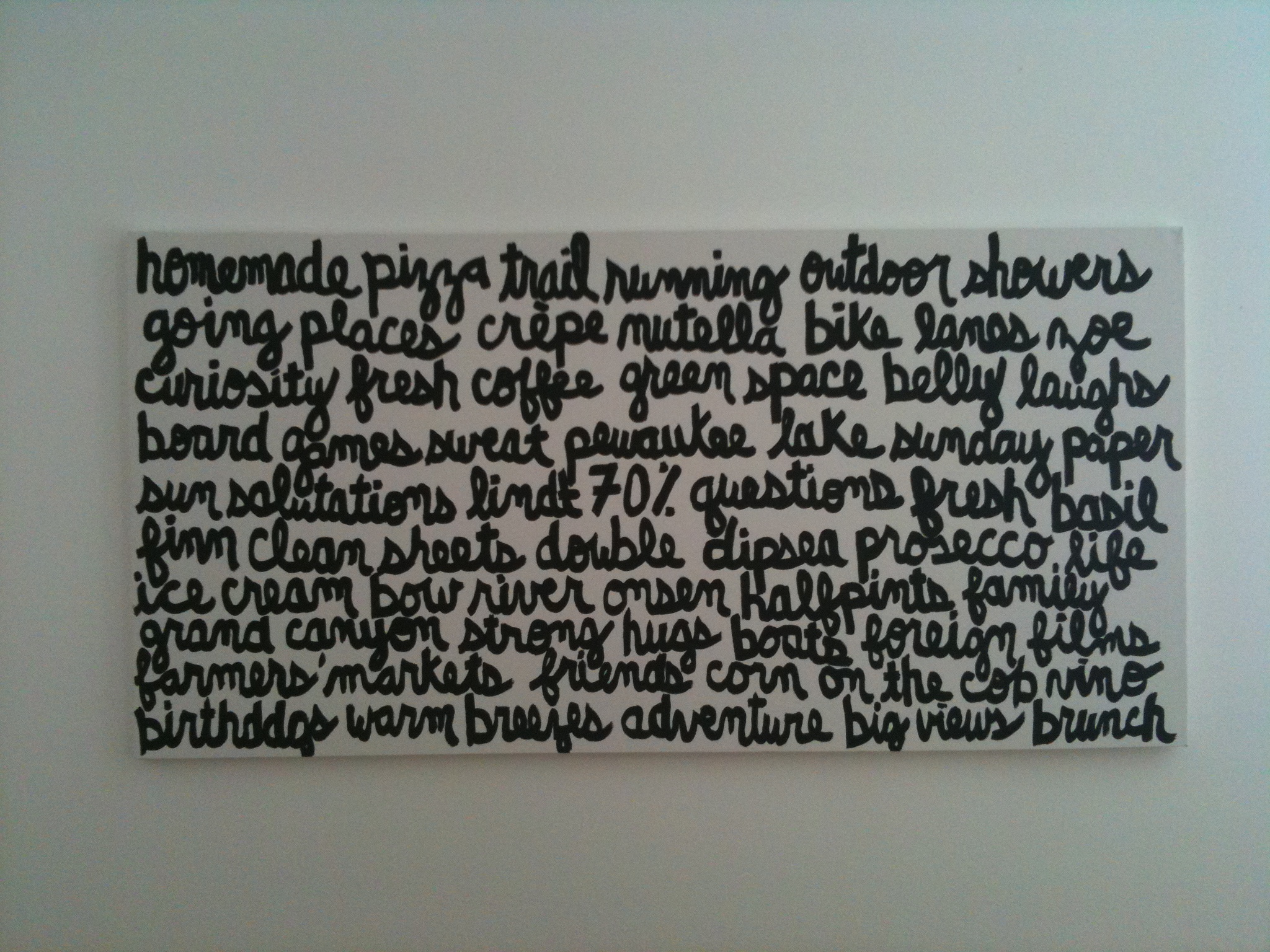
Today’s Idea: Surround yourself with visual reminders of the people, places, and things you love.

Going about our everyday lives, it’s all too easy to forget what matters to us most — who we are at the core…what brings us joy…what we love.  There are tons of ways to prompt ourselves to remember — first, doing these things (duh), but when that’s not possible, surrounding ourselves with photos and artifacts and music and books that transport us to times when we really felt like ourselves.

One of the cues that works for me is a painting I made a few years ago.  I love art (and believe that making stuff makes us feel whole), but am not that good at it, so it’s very basic and quite rough.  So it wouldn’t ever hang in a museum, but it does hang on our kitchen wall every day to remind Sean and me of some of the little and big things in life we love.  Here it is:

word art

Have you ever made something that really captures who you are and what you love?  What was it, and where is it today?

Orienting (Your To-Do List and Your Life) Around Impact

photo by rebecca siegel, via flickr creative commons

photo by rebecca siegel, via flickr creative commons

I have extraordinarily clear memories of the first few months in my first job out of college.  Lots of things stick out; to name a few: eating oatmeal and drinking a cup of watery Keurig coffee every single morning because it was free at the office…my first-ever office holiday party (James Bond themed with casino tables and everything)…recording my voicemail message like 15 times until I thought it sounded even remotely professional.

But one of things I remember most was my dysfunctional relationship with my to-do list.  I was terrified to leave work without checking everything off.  I can picture the list now…three things left on it…staring at me at 6pm when all I wanted to do was go to boxing class.  Inevitably, I’d either stay to finish them or show up super early the next morning to have them done before the day started.  The feeling of being productive didn’t outweigh the constant nagging that I wasn’t getting to do the things outside of work that I wanted to do.

At some point, however, I realized that I didn’t need to finish everything on the list every day.  It was OK to start the day with a dirty slate; the real challenge was in choosing the right things to knock off the list every day.  Thank goodness I (sort of) figured out what I could leave unfinished versus what I couldn’t before life became complicated (and beautified) by hobbies and new friends and a husband and children.  Figuring this out is an art, not a science; and I’ve played around with a few different ways to manage my to-do list: doing the hardest things first thing, doing the things I love before everything else, organizing by deadline, and organizing by impact.  My most recent lens has been impact.  I think it’s something people should talk more about, and I wish it’s something I would have thought about earlier in life.

IDEA: ORIENT YOUR LIFE…YOUR DAYS…AND YOUR TO-DO LIST BY IMPACT.  IMPACT ON ANOTHER PERSON, ON A PROJECT, ON YOUR COMMUNITY, ON YOUR FAMILY, OR ON THE WORLD.  WHATEVER MATTERS MOST TO YOU ON THAT DAY/DURING THAT PHASE OF LIFE.

Why impact?  Here are five reasons:

  1. Impact requires us to think about the broader context in which we’re living/working.  It requires some level of connection to the people, places and things around us.  It forces us to think beyond what makes us happy and dig into what gives us meaning.
  2. Impact doesn’t need to be tied to hours.  Sometimes it is, but it’s possible to make a huge impact in a very short amount of time.  I’d love to see more companies orient around impact versus time.
  3. Impact makes trade-offs easier.  It’s easier to give something up in service of getting something done if you have a good understanding of the scope of the outcome.
  4. Impact gets noticed.  Yes, it’s critical to praise the process (especially with kids), but at the end of the day, people impact does matter.
  5. Impact feels good.  It’s bigger than just you.  It can change a mindset.  It can change a life.  It can even change the world.

So how does this work?  Well, here’s how it works for me:

  • I’m clear about the things I want to impact in my life.  For me, some of these include my family’s happiness, my children’s sense of self, people’s overall well-being, the way organizations support personal growth and work/life integration, what the future of work might look like.
  • Every week, I think about what I’m going to focus on most.  I then ask myself why each of those areas/items matters, and based on those responses, I prioritize my list and my time.
  • I then think about what I need to do to make those things happen (i.e., Do I need workouts to give me energy?  Do I have little mundane tasks that are distracting me enough that I should knock them off too?), and i add those to the list.
  • I make a list of “must do” items and keep my list of “would be great to get these things done” items.  I try hard to not touch the second list until I finish what’s on the first.

Orienting around impact isn’t easy.  It’s muddy and imperfect, and it can sometimes create meaning/fulfillment but not necessarily in-the-moment happiness.  But it’s one of the many tools we have in our toolkit as we move through life.  And it’s one that is helping me navigate the trade-offs I make every day and every week.

What works best for you?  How do you organize the things you need to get done (and are lucky enough to have any choice about) every day?

Virayoga Inspiration

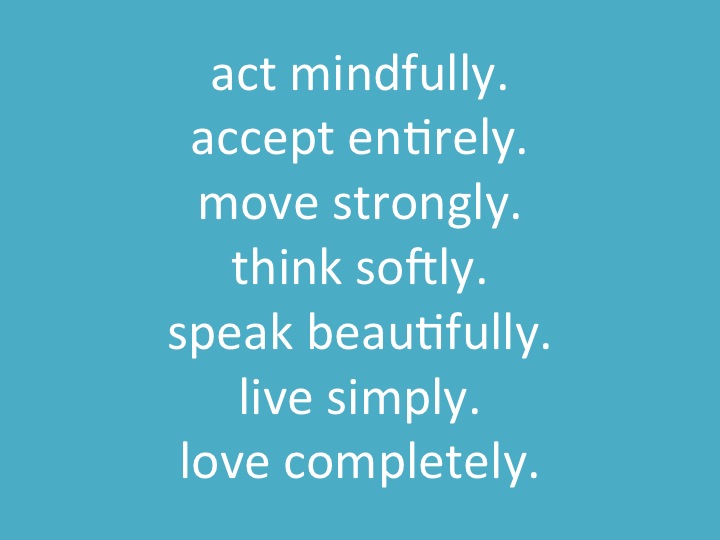
I’ve posted in the past about the power of mantra, or “a sacred utterance (syllable, word, or verse) believed to possess mystical or spiritual power. Mantras may be spoken aloud or uttered in thought, and they may be either repeated or sounded only once. Repetition of a mantra can induce a trancelike state and can lead the participant to a higher level of spiritual awareness.”  So on the three-month anniversary of starting this blog, I thought I’d post another simple one that has guided my life ever since I came across it in a Virayoga newsletter a few years ago…

virayoga quote

This simple set of phrases migrated from an e-newsletter to a post-it note to my chalkboard to a deep part of my memory where it lays the foundation for what matters most.  What mantra do you rely on?  Where did it come from, and why did it stick with you?

Inspired by Travis Leach

inspireAs the quest for perspective evolves into one of the topics I seem to come back on this blog, I wanted to share an excerpt from a book I’m reading — The Power of Habit, by Charles Duhigg (great read, btw).  In his section about “The Habits of Successful Organizations,” Duhigg shares the story of Travis Leach, a now 25-year-old manager at Starbucks whose life changed after he went through Starbucks’ professional development classes.  Here’s an excerpt from the book:

“The first time Travis Leach saw his father overdose, he was nine years old.  His family had just moved into a small apartment at the end of an alleyway, the latest in a seemingly endless series of relocations that had most recently caused them to abandon their previous home in the middle of the night, throwing everything they owned into black garbage bags after receiving an eviction notice….On the morning of the overdose, Travis and his brother were playing in the living room on top of blankets they laid out on the floor each night for sleeping.  Travis’s father was getting ready to make pancakes when he stepped into the bathroom.  He was carrying the tube sock that contained his needle, spoon, lighter, and cotton swabs.  A few moments later, he came out, opened the refrigerator to get the eggs, and crashed to the floor.  When the kids ran around the corner, their father was convulsing, his face turned blue….

When Travis turned sixteen, he dropped out of high school….He got jobs at McDonald’s and Hollywood Video, but when customers were rude, he would lose control….Sometimes he’d get so upset that he would start crying in the middle of a shift.  He was often late, or he’d take a day off for no reason….When the line at his register would get too long and the manager would shout at him, Travis’s hands would start shaking and he’d feel like he couldn’t catch his breath.  He wondered if this is what his parents felt like, so defenseless against life, when they started using drugs.

One day, a regular customer at Hollywood Video who’d gotten to know Travis a little bit suggested he think about working at Starbucks.  ‘We’re opening a new store on Fort Washington, and I’m going to be an assistant manager,’ the man said.  ‘You should apply.’ A month later, Travis was a barista on the morning shift.

That was six years ago.  Today, at twenty-five, Travis is the manager of two Starbucks where he oversees forty employees and is responsible for revenues exceeding $2 million per year.  His salary is $44,000 and he has a 401(k) and no debt.  He’s never late to work.  He does not get upset on the job….’Starbucks is the most important thing that has ever happened to me,’ he said.  ‘I owe everything to this company.'” (The Power of Habit, pp. 128-130)

Maybe it was an emotional day or maybe it’s because ever since becoming a parent, I get overwhelmed when I think about the situations some kids grow up in, or maybe because it’s a beautiful success story, but Travis’s story moved me.  Here are a few thoughts it inspired:

  • Perspective: People are born into insane situations and find ways to persevere and start fresh and do amazing things.  When it feels like life is tough, or we’re not sure what to do to move forward, thinking about stories like Travis’s add perspective.  If a kid who phoned in his dad’s crack overdose at age 9 can create a life he’s proud of, anyone can.
  • Life Impacts Work and Work Impacts Life: Increasingly, I don’t believe in balance on a day-to-day basis, but I do believe in it when we consider a full lifetime.  The reality is that we don’t have work life and life…it’s all one life.  And our interests and experiences and challenges and successes in our personal spheres impact our work…and our work structure, content, community and support system impact our lives.
  • Employers Have a Huge Opportunity:  Companies can change lives by creating environments in which people can grow + thrive…just like Starbucks did for Travis.  If this happens, those people can go out into the world and change lives themselves.  Health begets health.  Healthy communities give way to healthy communities.
  • There’s More Than Meets the Eye: Everyone we meet has a story.  Each story might not be as dramatic as Travis’s, but each story matters.  And taking the time to genuinely learn people’s stories — at work, at the coffeeshop, at the hair salon, getting your oil changed, buying your groceries — can build bridges between people and helps us more deeply understand the human experience.

I sincerely believe that the more we learn about people overcoming incredible odds to find joy and success (however they define it), the harder we’ll work to get, be, and stay well.  What do you think?  Did reading about Travis make you think differently about your life, your intentions, and actions, and your opportunities?  Who has inspired you lately?

P.S. If you like the themes of perspective and perseverance, check out the story about Robert Brady I posted on my Facebook wall this week.

Wisdom 2.0

photo(10)Who would have ever thought the Chairman of Ford would share the stage with Buddhist monk and spiritual guru Jack Kornfield?  Or a leader from Twitter would interview Jon Kabat-Zinn about the role mindfulness plays in modern day work and life?  Or a start-up leader would stand in front of a few thousand people, share photos of his communal living space, and lead a short, guided meditation about smiling at the bus stop?  Or a technologist turned artist would comfortably strut barefoot across a stage at a “business” conference and talk about her journey as a human being? Read more

Looking Outward to Look Inward

photo by dawn ashley via flickr creative commons

photo by dawn ashley via flickr creative commons

In one of my very first posts on this site, I talked about the power of perspective, and I’ve been meaning to return to this theme ever since.  The sense of perspective I felt the morning I wrote that post – shortly after hearing about the incomprehensible shooting in Newtown – arrived like a thunderstorm, surrounding and consuming me in a way I couldn’t see coming.  While obviously (and thankfully) not with the same intensity I felt it that morning, I think about perspective a lot, particularly as I write about first-world luxuries like juice cleanses and spin classes and choosing to have relationships with people I love. Read more

Alphabet Scramble

Learning from parenting and life, while trying to get dinner on the table

The Lemonade Chronicles

A quixotic quest for the bright side.

mamajamas mom

don't sweat the baby stuff

The Development Sherpa

by SBK & Associates

wellfesto

hacking health, designing life

Rudeysroom

Rudey's Room

Building Customer Driven SaaS Products | Jason Evanish

Posts with strategies and tactics on building great products and how to be a better leader

The Blog of Author Tim Ferriss

Tim Ferriss is the author of five #1 New York Times bestsellers and host of The Tim Ferriss Show podcast.

Reflections Corner

hacking health, designing life

The Marginalian

Marginalia on our search for meaning.

Greater Good: Parenting & Family

hacking health, designing life