Skip to content

Five Ways to Drink More Water

water glassAn infographic comparing water and Coke was circulating the web earlier this week.  When I did some digging, it sounds like the info about Coke (which was SUPER DISTURBING) contained some inaccuracies, so I’m not re-posting it here.  What I am posting here, however, are the statistics about water:

  • 75% of Americans are chronically dehydrated
  • In 37% of Americans, the thirst mechanism is so weak that it is often mistaken for hunger
  • Even MILD dehydration will slow down one’s metabolism as much as 30%
  • One glass of water will shut down midnight hunger pangs for almost 100% of the dieters studied
  • Lack of water is the #1 trigger of daytime fatigue
  • Preliminary research indicates that 8-10 glasses of water a day could significantly ease back and joint pain for up to 80% of sufferers
  • A mere 2% drop in body water can trigger fuzzy short-term memory, trouble with basic math, and difficulty focusing on the computer screen or on a printed page

This is not new news.  We are told from little on that “eight glasses a day keeps the doctor away,” and for me, water consumption is a great example of the reality that information does not equal behavior change.  I know that most days I don’t drink enough water, and my excuses are endless: I feel nauseous when I drink water on an empty stomach…I feel too full when I drink it with my meals…I don’t like it sloshing around in my stomach during workouts…I race from workout to shower without taking the time to drink…it’s BORING…

So I’m working on this.  Really working on it.  Trying to put structures and incentives in place to get myself to drink enough water to keep my brain clear and my energy up.  Here are a few things that are helping:

  • SodaStream: I like fizzy water much more than plain old boring water, so our at-home carbonator is a huge help.  I usually mix 80% water with 20% juice to make the drink more appealing
  • Emergen-C: Vitamin C + a little bit of flavor helps the medicine go down
  • Tea: A mid-afternoon glass of decaffeinated tea is hydration I can look forward to.  My favorites are ginger and licorice root
  • Workout Hydration: I am trying to make my water bottle just as important as my ipod during workouts.  This is obviously a no brainer, but more easily said than done
  • 8oz Before Bed: I find that I sometimes wake up thirsty, and drinking a full glass of water before bed helps.  Plus, the more I do it, the more it becomes a habit!

Might you be chronically dehydrated?  If so, what are you doing to guzzle more (and ideally enjoy it)?
My Cohousing Dream

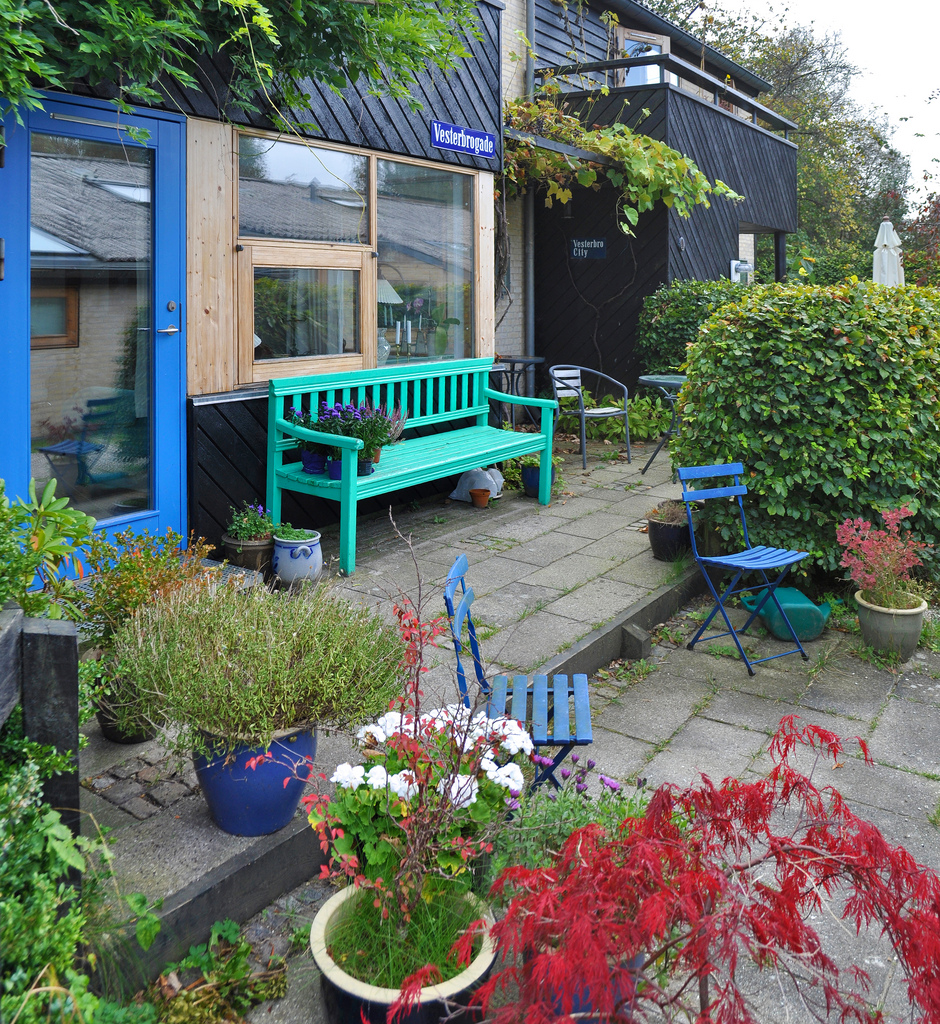
cohousing community in denmark; photo by seier + seier via flickr creative commons

cohousing community in denmark; photo by seier + seier via flickr creative commons

I recently watched the documentary Happy, an hour-long 2011 film that tells happiness stories from around the world.  Perspectives from both everyday people in places like swampy Louisiana and Kolkata’s slums, as well as leading experts in positive psychology and happiness get at the essence of what really makes people happy.  The messages are familiar (money doesn’t equal happiness), but the way it’s told is beautiful and human and real.

I was pretty sleepy when I watched it, so i admittedly drifted in and out of portions of the film.  But one segment really stuck with me.  It was about the world’s happiest country at the time (SPOILER ALERT): Denmark*.  This wouldn’t have been the first country I would have guessed, but when I heard it, it made sense.  Great public programs, excellent education, low unemployment, a strong middle class, and strong societal feelings of trust and safety all contribute to high happiness, as measured by the Organization for Economic Co-operation and Development (OECD) and the Happy Planet Index (HPI).  But the story that stuck with me most was told by a woman living in a “cohousing” arrangement.

As wikipedia describes it, a cohousing community is “an intentional community composed of private homes supplemented by shared facilities.”  Residents share in everyday activities such as cooking, dining, child care, gardening, and governance.  Basically, it’s like college/retirement homes, but everyone has their own full house and the community is more varied and multi-generational.  The cohousing movement began in Denmark in 1964 when an architect brought together a group of friends to discuss possibilities for a more supportive living environment.  Cohousing is now a well-established housing option in Denmark, and it continues to grow around the world.

The woman interviewed in Happy about her cohousing arrangement was pretty convincing (she jolted me out of near-REM sleep).  She cooks just a few times a month…her children have built in playmates…she can run out to the grocery story to get milk anytime because there is someone around to watch her kids…she has grown-up friends to eat dinner with every night…she has more amenities/facilities than she could ever have living on her own.  In short, she has community — something we know from research has a strong positive impact on our overall well-being.

I love love love the idea of cohousing.  Yes, maybe because it’s just an idea for me now and I’m not packing up our stuff in a Penske quite yet, but maybe because it’s something we as a society actually need.  People don’t consistently live near their parents and siblings anymore.  Housing is insanely expensive in some places.  Neighborhood schools aren’t always a given, reducing the natural community that they bring.  Finding good childcare is time-consuming and stressful.  And people are overall maxed out.  Life really does take a village.  And I’m not talking about a clothing optional, Big Love kind of village…just a normal, hip, cool, interesting one full of varied and curious and compassionate people.

So if I could design my own community, here’s what it might look like…

  • Mixed ages — elderly people, families, 20-somethings…united by a common commitment to community
  • Shared meals — maybe as a large community, maybe in smaller sub-communities
  • Guest housing — for family members and friends from out of town
  • Big, beautiful garden — manageable with lots of waterers…
  • Swimming pool — of course
  • Outdoor showers — because I love them
  • Art room — for kids and grown ups
  • Ample space in each single home — privacy would be even more important in a cohousing situation

What do you think?  Does this idea make you want to learn/explore more or buy a single family compound on 20 acres where you wouldn’t have to interact with anyone unless you made a big effort?  Do you know anyone who lives in a cohousing community and loves or loathes it?

*Note: Denmark is no longer the world’s happiest country, according to the Happy Planet Index (HPI).  Costa Rica took its place in 2012.

The Toughest Footrace on Earth

MDS

Today marked the end of the fourth stage of the Marathon des Sables — a 150-mile footrace across the Sahara dubbed “the toughest footrace on earth.”  Now in its 28th year, the MdS as it’s most commonly called is a six-stage, self-supported adventure race across the desert.  Self-supported means that you carry everything you’ll need throughout the race (clothes, food, sleeping stuff, etc); the only support offered by the race is water and a tent to sleep in.  Here’s what the six stages (over seven days) look like:

  • Day 1: 29km
  • Day 2: 36km
  • Day 3: 40km
  • Day 4: 82km
  • Day 5: Rest Day
  • Day 6: 42km
  • Day 7: 21km

I spectated this race (well the start and finish of it) in 2005 when my husband participated, and can attest to the fact that it’s grueling, thrilling, and very, very special all at the same time.  It takes an extremely strong person to put in all the training and do all of the preparation required to get to Morroco, have the courage to start, and have the stamina and commitment to finish the race.  I was moved to tears at the end of it, and now — eight years later — I still find myself transported to the unforgettable experience.

If you’re interested in learning more, here’s a video that will inspire you to cheer this year’s participants on…and maybe even do the event yourself one day!

Weekly Menu

menuA few years ago, Sean and I spent a totally, ridiculously disproportionate amount of time at the grocery store.  We went 3-5 times/week because we were never very thoughtful about what we bought and how it related to what we might want to cook that week.  While some people can whip up something amazing using whatever’s in the fridge, we’re not those people.  We can cook, but we need a plan….and we’re better off if we have a recipe.  So finally, after having our second child and realizing that hauling two kids to the grocery story multiple times each week wasn’t sustainable or fun, we started putting together a weekly menu.  It takes some work, but a weekly menu has cut our shopping time, saved us money, taken away the stress of trying to figure out what to make every night, and better allowed us to share responsibility for feeding our family.  Oh, we don’t eat bread, cheese, salad and wine every single night for dinner anymore.

So how does this work?  Here’s our system:

  • Saturday or Sunday, one of us takes the lead on planning a menu for that week.  We plan four meals, assuming that we’ll either eat out or eat leftovers one night during the week.  We have a chalkboard in the kitchen where we write down what’s on the menu each day of the week
  • We survey what’s in the fridge and make a list of what we’ll need for that week’s meals and then divide the list by what we need to get at Trader Joe’s versus Whole Foods versus the farmer’s market (I know, this isn’t very efficient, but unless Trader Joe’s starts sourcing better produce and meat, we’ve got to do it)
  • We prep what we can (cutting veggies, washing lettuce, etc on the weekend) when we can.  I wish we were better about this, but takes commitment
  • We keep any recipes we’re using in a recipe box at Epicurious.com (I’m sure there are lots of organizers out there, but this is the one we started using, so now it’s tough to switch)
  • We make family meals.  If the kids don’t want to eat salmon, tough luck.  It’s difficult enough to make one meal at night, much less two!
  • We stick to our menu (for the most part)!  And having a fallback go out/eat leftovers/make eggs option takes the pressure off

So what’s on the menu this week?

  • Mon – off the hook (going out with friends)!
  • Tues – roasted chicken thighs with carrots and sweet potatoes, green salad
  • Weds – broiled salmon, rice pilaf, green salad
  • Thurs – chicken, broccoli, and red pepper stir-fry
  • Fri – asparagus/leek soup (in the Vitamix), grilled sausage, green salad

What’s your system for cooking at home in as little time as possible?  Do you have a few “go-to” menus?  Do you prep everything on the weekend?  Do you trade off meal duty with your partner?  And if you have a weekly menu to share, please send or post it, as I’m always looking for ideas!

Loved It/Loathed It

loved it/loathed itIn order to make changes in our lives, we need to know what exactly we want to change.  It’s like any other question — we need to understand the problem before we can drive toward a solution.  And understanding the problem actually takes a bit of conscious effort…

For example, let’s say I feel frustrated at work.  The root cause of this could be lots of different things — the people I interact with most, the level of autonomy I have, the impact I feel I’m making on the world, the level of work-life integration I have, or the tasks that make up each day.  Before I can go about making changes and improvements, I need to understand what I need to do more of and do less of in order to migrate to a future state that feels less frustrating (and ideally even good).

Best-selling author and strengths-based development guru Marcus Buckingham offers a super simple way to approach this introspective work.  It’s an exercise he calls “Loved It/Loathed It.” Here’s how it works:

1) Create a sheet of paper with two columns — I Loved It, and I Loathed It

2) Carry this sheet of paper around for a week and whenever you notice an activity (at work or outside of work) that you love or loathe, make note of it (do it in the moment, not at the end of the day…it should only take a minute)

3) By the end of the week, you’ll have two columns of activities.  Review the lists, and think about the activities you want to do more of and do less of

4) Identify three simply ways you can do more of the things you love at work, and build a support system (your boss, your peers, your friends) that can help you make sure this happens

It’s obviously not useful to do this exercise every week or even every month, but it’s a great tool during times of transition and/or as an annual refresh/check-in.

Have you ever done this exercise?  Has it helped clarify new insights about your life?  Have you been able to make actionable changes based on what you learned?


21st Century Postcards

photo by counselman collection, via flickr creative commons

photo by counselman collection, via flickr creative commons

I’m a luddite in some respects, and I always have been.  As a kid I wanted to be Laura Ingalls, and I dreamed of eating by candlelight and panning for gold and walking to school and running free on a 19th century farm.  I even begged my mom to make me a long gown and bonnet and get me a metal lunch pail to take to school (totally weird, I know).  And even today, I love old-fashioned things like hand-written letters and physical (versus online) stores and paper lists.

In light of my tendency to yearn for the simplicity of the past, it’s ironic that I now live in the land of the future — Silicon Valley.  But I love the future too.  Surrounded by things and people and ideas revolving around technology, it’s hard to not feel excited about the promise of innovation.  I love the way technology helps me keep track of information and stay connected to people and see my parents who live thousands of miles away and learn new things and understand the world around me.  But at the end of the day, I don’t think technology can replace the joy of physical relationships and tangible goods.  I think they need to gracefully co-exist.

One of the most concrete examples of this is the mailbox.  I don’t want it to go away, despite the rise of companies focused on virtualizing mail.  I love finding real letters in the mailbox…feeling the paper and seeing a loved one’s handwriting and knowing they took the time to sit down and write something.  My mom is really great at this (thanks, mom)!

So…in an attempt to marry my real life with my virtual life, I just tried out a postcard app called Postagram.  It was simple: upload photo from phone, write short message, upload address (I sent one to my sister), pay, and hit “send.”  Yes, my sister won’t get a handwritten card, but she will get a smiling photo of my 4-yr-old in a tie when she opens her mailbox one day next week!  This whole process took me under three minutes, and it’s a great way to communicate in a new and interesting way.

If you like this idea, there are lots of companies in this space:

How do you stay in touch with your loved ones?  Do you love real letters, or think of them as a thing of the past?

Curtis Camp

WIP

My former running partner and dear friend Karisa Curtis is working with a team to start up a new fitness concept called Work in Progress (WIP) in West Hartford, CT.  I can’t imagine a better person to get a new gym off the ground.  Karisa is an elite athlete (ran at cross-country and track at Brown and qualified for the World Triathlon Championships in Kona), and she’s also a super fun, awesome, motivating person and badass mom to two adorable little kids.  That’s a long way of saying, I’d totally trust her workout advice and personal training over almost anyone else’s.

So…I asked Karisa to put together a simple 45-50 minute workout that can easily be done at home, as I’m always looking for fitness inspiration and I’d guess you are too.   Here it is…let’s call it “Curtis Camp”…

What You’ll Need:

  • Stopwatch or a timer app (an easy one for the phone is called Seconds Pro, which lets you set up the several timers you need for this workout using “Round Timer”)
  • Dumbbells (10-25 lb)
  • 2 small towels (washcloths)
  • Exercise bands (optional, if you have them)

The Warmup:

  • 5 minutes of foam rolling, if you have a foam roller
  • 10 minutes of running, pedaling on a stationary bike/bike in a trainer, or a variety of dynamic lunges, stretches, and jumps or drill-like exercises (high knees, butt kicks, leg swings, fast feet, skipping, bounding, etc)

Core Workout: 5 total exercises: 50 seconds work/10 seconds rest

  • High plank (hands on ground)
  • High plank, drop down to low plank (elbows on ground, thumbs facing to sky), back up to high plank, alternating sides coming up
  • Spiderman low plank (alternating right knee towards right elbow, left knee towards left elbow)
  • Side plank (switch sides after 25 seconds)
  • Glute bridge (on back, feet flat and knees up, arms at side and palms up, lift hips to sky and hold)

Ramp Up:  12 rounds of 8 seconds work/12 seconds rest

  • Stationary sprints (knees up high and as fast as possible), face down on stomach for rest

Main Circuit:  5 rounds of 5 exercises, 30 seconds work/15 seconds rest (continuous)  

  • Push ups (progression: can put a band around lower back for more resistance, elevate legs on a coffee table, roll a medicine ball or basketball from hand to hand in between pushup)  **drop to knees if needed
  • Burpees
  • Mountain climbers (option: if you have hardwood floors, put a small towel like a washcloth under each foot and alternate sliding each foot in from plank position as fast as possible)
  • Hamstring curls (lie on back with towels under feet, lift hips up to sky, slide feet all the way out and all the way in without dropping hips to floor; can also use a large exercise ball instead of towels)
  • Squat and press with dumbbells (rack dumbbells at shoulders facing forward like flashlights and squat all the way down so that elbows touch knees; as you come up, press dumbbells overhead)

Finisher:  8 rounds of 20 seconds work/10 seconds rest

  • Jump squats (squat low, jump high; progression:  hold squat during rest)
  • Never ending ladder for 4 minutes:  3, 3, 6, 6, 9, 9, 12, 12, 15, 15, etc.  alternating between doing burpees and pushups

FINISHED!

Doing this workout at full intensity takes self-discipline,  focus and commitment…but if you can make it through, this is an amazingly efficient and effective workout.  Thanks, Karisa — for the motivation and the inspiration!

What are your favorite workouts to do at home?  What keeps you going (a workout partner, music, etc)?

Autonomy + Flats

Tina Fey Quote

My sleep and workout time trumped my writing time this morning, so with just a few minutes to post, I thought I’d share something that I’ve loved ever since I read it for the first time a few years ago.  It’s a short piece of advice from Tina Fey with a big message: “lead her [toward] something where she can make her own hours but still feel intellectually fulfilled and get outside sometimes and not have to wear high heels.” Read more

Hungry or Craving?

photo by la grande farmers' market, via flickr creative commons

photo by la grande farmers’ market, via flickr creative commons

I recently read a tip about diagnosing cravings that has changed the way I think about food (hasn’t fully changed my behavior, but it’s definitely made me much more aware of my choices).  In their bestseller, It Starts with Food, Whole30/Paleo enthusiasts Dallas and Melissa Hartwig suggest asking yourself a simple question when you’re trying to figure out if you’re truly hungry or just craving something:

“Am I hungry enough to eat steamed fish and broccoli right now?” 

If the answer is no, then you’re not really hungry; you’re craving.  When this happens, the authors suggest doing something other than snacking (going for a walk, calling a friend, drinking a glass of water are all good options).

Now, these guys are the hardest of the hard core in the eating department — eating a diet free of grains, sugar, legumes, dairy and alcohol — not just for the 30 days their book advocates, but for life.  We’re not all going to eat like them, but as with anything else, we all can learn from them.  We can take little pieces  (or big pieces) of wisdom from their program and incorporate it into our lives.

The steamed fish and brocoli visualization is one of the pieces I’ve borrowed, and I come back to it each day when I find myself reaching for a piece of fruit or handful of almonds or steaming bowl of oatmeal (my comfort snack) or piece of chocolate.  Sometimes I stare at that plate in my mind and still choose to indulge my “craving,” but I do it less than I used to, and when I do, it’s a conscious decision, not a mindless act.

What tips have you picked up from friends or experts that have changed the way you eat?  Do you subscribe to ideas from one nutrition “guru,” or do you pick and choose to customize your own plan? 

Less Dissatisfaction, More Desire

A short video entitled “What If Money Was No Object?” re-emerged in my Facebook feed last week.  During the past few months, I’ve noticed it sporadically gain momentum, die down, and come back again a few times.  I watch it every single time, and albeit a bit “self-helpy,” I find it grounding and compelling in its simplicity.  And lot of other people do too — I’m amazed by the range of people (ages, vocations, lifestyle) who post and/or comment on it.  If you haven’t watched it, consider taking three minutes and nine seconds to watch it now…

http://www.youtube.com/watch?feature=player_detailpage&v=2L_cGjQSR80 Read more

Alphabet Scramble

Learning from parenting and life, while trying to get dinner on the table

The Lemonade Chronicles

A quixotic quest for the bright side.

mamajamas mom

don't sweat the baby stuff

The Development Sherpa

by SBK & Associates

wellfesto

hacking health, designing life

Rudeysroom

Rudey's Room

Building Customer Driven SaaS Products | Jason Evanish

Posts with strategies and tactics on building great products and how to be a better leader

The Blog of Author Tim Ferriss

Tim Ferriss is the author of five #1 New York Times bestsellers and host of The Tim Ferriss Show podcast.

Reflections Corner

hacking health, designing life

The Marginalian

Marginalia on our search for meaning.

Greater Good: Parenting & Family

hacking health, designing life